Wheelchair-Accessible Equipment

Wheelchair Accessible Play Equipment

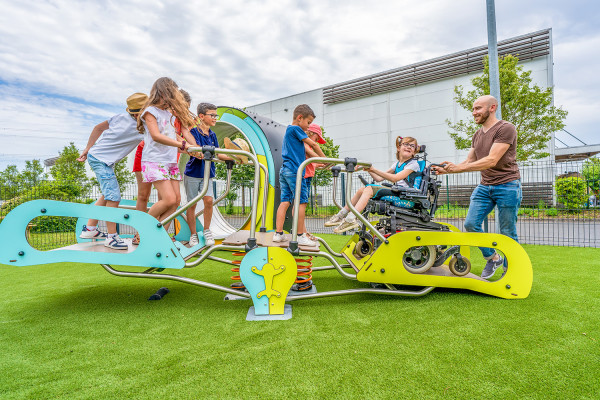
Wheelchair accessible play equipment is designed so children who use wheelchairs or walking aids can get on, hold on and play alongside their friends, not watch from the sidelines.

Wheelchair Accessible Play Equipment

What Is Wheelchair Accessible Play Equipment?

Wheelchair accessible play equipment is outdoor play kit shaped around mobility needs and designed to BS EN 1176, so a child who uses a wheelchair or a walking aid can get on, hold on and play alongside their friends. It covers ground-level roll-on roundabouts, wheelchair-platform swings, roll-on carousels, accessible trampolines and raised activity panels reached from a seated position.

Transfer points and step-free routes let a child move from a wheelchair onto the equipment, or stay in the chair and still take part. Real access is the whole journey, not one item, so we plan the route in a firm surface such as wet pour, the flush deck a wheelchair rolls onto, and the restraint or handrail that holds a child steady while a piece moves.

How Does Wheelchair Accessible Play Equipment Work?

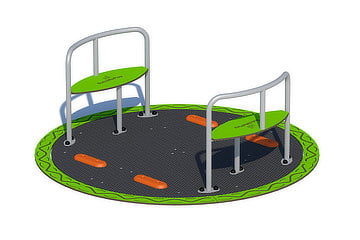
A wheelchair accessible roundabout works by sitting flush with the surrounding surface so a manual or powered wheelchair rolls straight on across a step-free deck, then locks against a restraint point while a stainless steel safety rail holds the child stable through the turn. There is no ramp lip to lift over and no transfer needed unless the child chooses one.

Wheelchair-platform swings take a chair directly onto a low, flush platform that clamps in place before it swings, and raised activity panels sit at a seated working height of roughly 600 to 900mm so a child reaches them without standing. Each moving piece keeps a clear BS EN 1176 safety zone, so the carousel or swing arc stays clear of children passing between activities.

Who Is Wheelchair Accessible Play Equipment For?

Wheelchair accessible play equipment is for every child in an inclusive playground, not only wheelchair users, and it suits SEN schools, mainstream primaries, nurseries and public parks across England and Wales. A six-seater accessible roundabout typically carries up to 6 users at once, including 2 wheelchair users, so children with and without mobility aids share the same game.

Age ranges run from about 2 years upwards to 3 to 14 depending on the piece, and the ground-level, transfer and seated-height options mean a child with a physical disability, a sensory need or limited balance can all join in. This goes beyond the baseline the Equality Act 2010 asks of schools and follows the accessible-environment guidance in BS 8300.

How Much Does Wheelchair Accessible Play Equipment Cost?

Wheelchair accessible play equipment costs around 4,000 to 15,000 pounds per piece supplied and installed, for items such as a roll-on roundabout or platform swing, with smaller inclusive panels lower and a six-seater accessible carousel toward the top. These are indicative UK ranges to confirm at survey, not fixed prices: the equipment itself, the flush installation, the fall-height surfacing beneath it and site access all move the figure.

A full inclusive play area combining several pieces with step-free wet pour routes commonly runs from about 15,000 pounds upwards. Because the range is modular, we phase it so a school can add pieces over more than one budget year rather than fund everything at once. For a firm number, talk to us about your inclusive play area and we will price your exact site.

What Standards Apply to Wheelchair Accessible Play Equipment?

Wheelchair accessible play equipment is governed by BS EN 1176, the playground equipment standard, while the safety surfacing beneath it is governed by BS EN 1177 for impact attenuation. The equipment must sit within a clear safety zone, and any surface under it has to reach a Critical Fall Height that equals or exceeds the equipment's free height of fall.

Access is also shaped by the Equality Act 2010, which requires schools and public bodies to make reasonable adjustments, and by BS 8300 guidance on accessible outdoor environments for step-free routes and clearances. We specify and install to BS EN 1176 and BS EN 1177 and can arrange independent RPII or RoSPA inspection where you want the finished area signed off; see our accessibility standards guide.

What Are the Specifications of a Wheelchair Accessible Roundabout?

A wheelchair accessible roundabout is built from hot-dip galvanised and powder-coated steel with HDPE deck and seat panels, and it measures roughly 2.1m wide by 2.1m deep and about 1.0m high, with a free height of fall near 1.0m. The flush entrance is wide enough for up to two standard wheelchairs or one large powered chair to roll on.

The deck sits level with the surface for step-free entry, restraint points secure each chair, and a stainless steel handrail rings the wheelchair bay so a child stays supported as it spins. Capacity is commonly up to 6 users including 2 wheelchair users, over an age range from about 3 to 14 years.

PieceTypical sizeFree height of fallMain materialsCapacity / age
Wheelchair accessible roundabout~2.1m x 2.1m, ~1.0m high~1.0mGalvanised + powder-coated steel, HDPE panels, stainless railUp to 6 users (2 wheelchairs), 3 to 14 years
Wheelchair-platform swingFlush platform ~1.5m x 1.5mSet by beam heightGalvanised steel frame, HDPE platform, restraint straps1 wheelchair, 3 to 14 years
Raised activity panelSeated height ~600 to 900mmGround levelHDPE panel, powder-coated steel postMultiple children, 2 years upwards

Indicative UK figures to confirm against your chosen manufacturer's specification at survey; dimensions and capacities vary by model.

How Long Does Wheelchair Accessible Play Equipment Last?

Wheelchair accessible play equipment lasts around 15 to 20 years in service when it is built from hot-dip galvanised, powder-coated steel and HDPE, because those materials resist corrosion and UV fade outdoors. Manufacturers commonly back the structure with a long guarantee on the steelwork and shorter cover on moving parts.

The moving components, the bearings, restraints and bushes on roundabouts and swings, are the wear items and are checked at routine inspection and replaced as needed rather than the whole piece being scrapped. We service and repair inclusive equipment so a worn part does not take a whole item out of use; the wet pour surface beneath it typically lasts 8 to 12 years on its own cycle.

What Are the Benefits of Wheelchair Accessible Play Equipment?

Wheelchair accessible play equipment lets children of all abilities play the same game side by side, which is where friendships form, and it turns the whole play space into somewhere every child belongs rather than watches from the edge. Step-free routes, flush decks and seated-height activities give a child real choice: transfer across or stay in the chair and still take part.

Ground-level pieces mean a wheelchair user and an ambulant child share one roundabout or swing, transfer points and restraints respect a child's independence and dignity, and a smooth wet pour route links every item with no lip or loose fill. We design past the Equality Act 2010 baseline so access is genuine, not just technically met; pair it with our inclusive swings and roundabouts for a fuller movement offer.

Why Choose Commercial Play for Wheelchair Accessible Play Equipment?

Commercial Play designs, supplies and installs wheelchair accessible play equipment in-house across England and Wales, so one team owns the job from survey to handover and gets the step-free route, the flush install and the BS EN 1177 surfacing right together. We survey each site, work out the fall height and the access line, then specify the equipment and the made-to-measure layout to match, not a house template.

We fit the equipment and the smooth wet pour surface that makes it reach, so the roll-on route is jointless and level with no trip edge between zones. We also service and repair inclusive pieces rather than default to replacement, extending what a school already has. See the full inclusive and SEN play range, and wet pour surfacing for the step-free routes that link it.

FAQs

Wheelchair-Accessible Equipment: common questions

What counts as wheelchair accessible play equipment?

It is equipment a child can use while seated in a wheelchair, or after transferring onto it, built and tested to BS EN 1176, such as roll-on roundabouts, wheelchair-platform swings and raised activity panels at seated height. The key is a step-free route to reach it and a flush, level way to get on or hold on.

Can a child stay in their wheelchair to play?

Yes, on many pieces they can. Roll-on carousels and wheelchair-platform swings are built to take a manual or powered chair directly onto a flush deck with a restraint point, and raised activity panels sit at roughly 600 to 900mm so a child works them from a seated position.

How much does a wheelchair accessible roundabout cost?

Indicatively a single wheelchair accessible roundabout or platform swing costs around 4,000 to 15,000 pounds supplied and installed, with a six-seater accessible carousel toward the top of that range. These are UK market figures to confirm at survey, as the surfacing beneath, the fall height and site access all move the price.

Is accessible equipment only for children who use wheelchairs?

No, it is used and enjoyed by everyone. A six-seater accessible roundabout carries up to 6 users at once, including 2 wheelchair users, so children with and without mobility aids play the same game together, which is the whole point of an inclusive playground.

What standards apply to wheelchair accessible play equipment?

The equipment is governed by BS EN 1176 and the safety surfacing beneath it by BS EN 1177, while access is shaped by the Equality Act 2010 and BS 8300 guidance on accessible outdoor environments. We install to these and can arrange independent RPII or RoSPA inspection on completion.

Do we need special surfacing for accessible equipment?

A smooth, firm, free-draining surface such as wet pour makes a real difference, because it gives wheelchairs and buggies a level route with no lip or loose fill. We match the surfacing to the equipment and its required fall height, tested to BS EN 1177; see our wet pour surfacing for the step-free routes.

What is a wheelchair accessible roundabout made from?

It is built from hot-dip galvanised and powder-coated steel with HDPE deck and seat panels and a stainless steel safety rail around the wheelchair bay. Those materials resist corrosion and UV fade outdoors, which is why a well-made unit lasts around 15 to 20 years in service.

How long does wheelchair accessible play equipment last?

Around 15 to 20 years for the galvanised steel and HDPE structure, usually backed by a long manufacturer guarantee on the steelwork. The moving parts, the bearings and restraints, are the wear items and are replaced at routine inspection rather than scrapping the whole piece.

How much space does a wheelchair roundabout need?

A wheelchair accessible roundabout is roughly 2.1m by 2.1m with a free height of fall near 1.0m, and it needs a clear BS EN 1176 safety zone around it so nothing strays into the turning arc. We plan the layout so these zones do not overlap and children can pass safely between activities.

The rest of the range

More inclusive & sen play options

Part of our full inclusive & sen play range, explore the other surfaces below.

Inclusive Swings & Roundabouts, Inclusive & SEN Play

Inclusive Swings & Roundabouts

Inclusive swings and roundabouts bring the joy of movement to every child, with nest swings, supportive cradle seats and level-access carousels that a wheelchair can simply roll straight onto.

View inclusive swings & roundabouts
Calm & Quiet Spaces, Inclusive & SEN Play

Calm & Quiet Spaces

A calm, quiet space is a sheltered outdoor retreat, a pod, den or planted nook, where a child can step away from noise and bustle to settle, breathe and self-regulate.

View calm & quiet spaces
Autism-Friendly Play, Inclusive & SEN Play

Autism-Friendly Play

Autism-friendly playground design shapes the whole space around predictability and choice, with clear zones, calm retreats and considered sensory input, so play feels safe rather than overwhelming.

View autism-friendly play
Accessibility Standards, Inclusive & SEN Play

Accessibility Standards

This guide explains what makes play genuinely inclusive beyond the legal minimum, from step-free routes and transfer-friendly equipment to sensory variety and quiet spaces, and how we design to it.

View accessibility standards
All inclusive & sen play

Thinking about wheelchair-accessible equipment?

Book a free site visit and we'll measure up, recommend the right surface and send a clear, fixed quote.