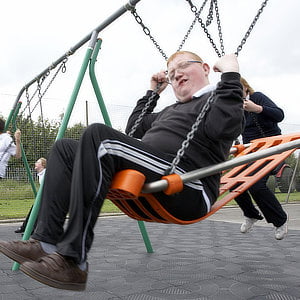
Wheelchair-Accessible Equipment
Wheelchair accessible play equipment is designed so children who use wheelchairs or walking aids can get on, hold on and play alongside their friends, not watch from the sidelines.
View wheelchair-accessible equipmentInclusive swings and roundabouts bring the joy of movement to every child, with nest swings, supportive cradle seats and level-access carousels that a wheelchair can simply roll straight onto.
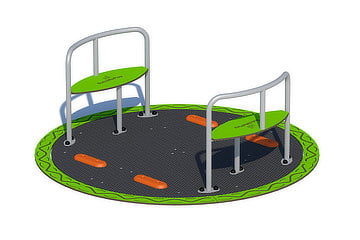
Inclusive swings and wheelchair roundabouts are movement-play pieces that let a child swing or spin regardless of mobility, and they are tested to BS EN 1176. The range covers nest and basket swings, supportive cradle and high-backed seats, wheelchair-platform swings, and level-access roundabouts that a wheelchair rolls straight onto and locks into place. Each piece is chosen so no child sits out the fun of movement.
Movement builds balance, calms the senses and simply feels good, so we specify pieces a child can share rather than use alone. A nest swing seats two children together, a cradle seat holds a child who needs support, and a level-access carousel spins gently with friends alongside.
A wheelchair roundabout sits flush with the surrounding surface and uses a short roll-on ramp so a chair moves straight onto the deck, where bump stops mark where to apply the wheelchair brakes before it turns. The deck is built from 18mm Hexastrong plywood with a non-slip wearing layer, and the high-pressure-laminate rim carries a contrast-colour edge that acts as a visual indicator for partially sighted children.
A nest swing works by spreading a child's weight across a large dished seat, so a child who cannot hold a flat seat still swings safely, and the polyester-covered galvanised rope suspends it from a hot-dip galvanised steel frame. We zone and space every moving piece with clear safety clearances, in line with BS EN 1176, so the arc of a wheelchair accessible equipment stays controlled and the area around it stays clear.
Inclusive swings and wheelchair roundabouts are designed for children of every ability in SEN schools, mainstream primaries, nurseries and public playgrounds, and most pieces suit ages 2 and above. A 6-seater level-access roundabout typically carries up to four seated users plus a centrally positioned wheelchair, so a chair user and their friends play the same game together rather than apart.
Nest swings are a firm favourite in SEN settings because the enclosing seat gives a reassuring sense of being held, supports a child who struggles to stay upright, and lets a child lie back and self-regulate through slow, rhythmic motion. We pair these pieces with the wider swings, springers and spinners range so a mixed-ability group finds something for everyone.
A level-access wheelchair roundabout costs around 4,500 to 12,000 pounds supplied and installed, and an inclusive nest or basket swing runs from about 1,500 to 4,000 pounds, with wheelchair-platform swings towards the top of that range. These are indicative UK ranges to confirm at survey, not fixed prices: the seat mix, the frame material and the level-access groundworks all move the figure.
Your final cost is driven by the piece, the number of seats or bays, the safety surfacing beneath it and site access, because a roll-on roundabout needs a level, step-free approach in a surface such as wet pour. Safety surfacing to the required fall height is priced separately; see playground surfacing. For a firm number we survey the site and price your exact layout.
| Piece | Typical users | Age range | Free fall height | Indicative installed cost |
|---|---|---|---|---|
| Nest / basket swing | 1 to 2 per seat | 2+ | ~1.4m | £1,500 to £3,000 |
| Wheelchair-platform swing | 1 chair | 3+ | ~1.4m | £3,000 to £4,000 |
| Cradle / high-backed seat swing | 1 per seat | 2+ | ~1.4m | £1,200 to £2,500 |
| Level-access wheelchair roundabout | Up to 4 plus 1 chair | 2+ | Ground level | £4,500 to £12,000 |
Indicative UK market ranges to confirm against a site survey. Surfacing to the required fall height is priced separately.
Inclusive swings and wheelchair roundabouts are governed by BS EN 1176, the playground equipment standard, while the safety surface beneath them is governed by BS EN 1177. Every moving piece needs a clear safety zone set by its arc of motion, typically about 1.75m to the front and back of a swing, so nothing and no one strays into the swing path.
We also design past the Equality Act 2010 baseline rather than just meeting it, because technical compliance and genuine access are not the same thing. The surface below must match the equipment's free height of fall, tested with a BS EN 1177 headform drop that passes only below a Head Injury Criterion of 1000, and we can arrange independent RPII or RoSPA inspection where you want the installation signed off.
A nest swing typically measures around 3,600mm long by 1,730mm wide by 2,538mm high with a free height of fall near 1.4m, so the safety surface below is built to protect that fall height. A level-access roundabout sits flush at ground level, and a 6-seater version needs a wide central bay to accept a range of wheelchair types with a roll-on, roll-off approach.
The dished nest seat spreads a child's weight, the cradle seat adds a supportive back, and the roundabout deck stays step-free so a chair reaches it without a lip or loose fill. We set out the safety zones so they do not overlap, keep the roll-on approach level, and match the surfacing to each fall height, tested to BS EN 1177.
Inclusive swings and wheelchair roundabouts typically last 15 to 20 years, because the steelwork is hot-dip galvanised inside and out with lead-free zinc for strong corrosion resistance in an outdoor setting. Bearings on many roundabouts are lifetime sealed and lubricated, and the polyester-covered galvanised swing rope resists weather and heavy daily use.
Lifespan holds up with routine inspection: we recommend an annual RPII inspection alongside regular in-house checks of ropes, seats, fixings and the roundabout bearing. Worn seats and bearings can be replaced rather than scrapping the whole piece, and we repair and refresh equipment rather than defaulting to full replacement; see playground repairs and maintenance.
Inclusive swings and wheelchair roundabouts let a child who uses a wheelchair feel the same motion as their friends, because a level-access carousel takes a chair directly and a platform swing removes the need to transfer. That shared movement does three more things well: it builds balance, it calms the senses, and it makes the play space more social rather than splitting children into separate areas.
A nest or basket seat is big enough to share, so swinging becomes a group game instead of a solo turn, and a cradle or high-backed seat holds a child securely for confident play. The contrast-colour roundabout edge helps partially sighted children judge the deck, and the step-free, jointless approach keeps every piece reachable, which matters for SEN and early-years settings.
Commercial Play designs, supplies and installs inclusive swings and wheelchair roundabouts in-house across England and Wales, so one team owns the job from survey to handover. We survey each site, plan the safety zones so no swing arc overlaps, and match the surface to each piece's fall height rather than fitting a template.
We fit the full inclusive range, from nest swings and cradle seats to platform swings and level-access roundabouts, so our recommendation follows the children who will use the space rather than one product. We also design past the Equality Act minimum for genuine, side-by-side play, and repair and refresh existing pieces to extend what a school already has.
An inclusive swing supports a wider range of bodies and needs through features like a dished nest seat, a supportive cradle or a platform that takes a wheelchair directly. It lets a child who could not manage a standard flat seat still enjoy the swinging motion, and it is tested to BS EN 1176 like any other playground equipment.
A level-access, or inclusive, roundabout sits flush with the surrounding surface and has a short roll-on ramp so a wheelchair moves straight onto the deck. Bump stops mark where to apply the chair's brakes, the deck is a non-slip 18mm Hexastrong plywood surface, and the roundabout then turns gently so the child spins alongside their friends.
Indicatively, a level-access wheelchair roundabout costs around 4,500 to 12,000 pounds supplied and installed, with a 6-seater at the upper end. The seat count, the frame, the safety surfacing and the level roll-on approach all move the figure, so we confirm the exact cost on a site survey.
Yes, nest swings are a firm favourite in SEN settings. The large, enclosing seat gives a reassuring sense of being held, supports children who need help staying upright, and lets a child lie back and self-regulate through slow, rhythmic movement. A nest swing seats two children, so it also works as shared, social play.
Each moving piece needs a clear safety zone set by BS EN 1176, typically about 1.75m to the front and back of a swing, so nothing strays into the arc of the motion. A nest swing measures roughly 3,600mm by 1,730mm plus that zone, and we plan the layout so the safety zones do not overlap and children pass safely between activities.
Most inclusive swings and level-access roundabouts suit children aged 2 and above, and a 6-seater roundabout typically carries up to four seated users plus a centrally positioned wheelchair. We match the seat type, from nest and cradle seats to platform swings, to the ages and needs of the children who will use the space.
A smooth, firm, free-draining surface such as wet pour makes a real difference, because it gives wheelchairs and buggies a level, step-free route with no lip or loose fill up to a level-access roundabout. We match the surfacing to each piece's free height of fall, near 1.4m for a nest swing, and test it to BS EN 1177.
They typically last 15 to 20 years, because the steel is hot-dip galvanised inside and out for strong corrosion resistance and many roundabout bearings are lifetime sealed. Worn seats, ropes and bearings can be replaced rather than scrapping the whole piece, which we handle through repairs and maintenance.
We recommend an annual RPII inspection alongside regular in-house visual and operational checks of ropes, seats, fixings and the roundabout bearing. Routine inspection is what keeps a well-built inclusive piece safe and usable across its 15 to 20 year life.
Part of our full inclusive & sen play range, explore the other surfaces below.
Wheelchair accessible play equipment is designed so children who use wheelchairs or walking aids can get on, hold on and play alongside their friends, not watch from the sidelines.
View wheelchair-accessible equipment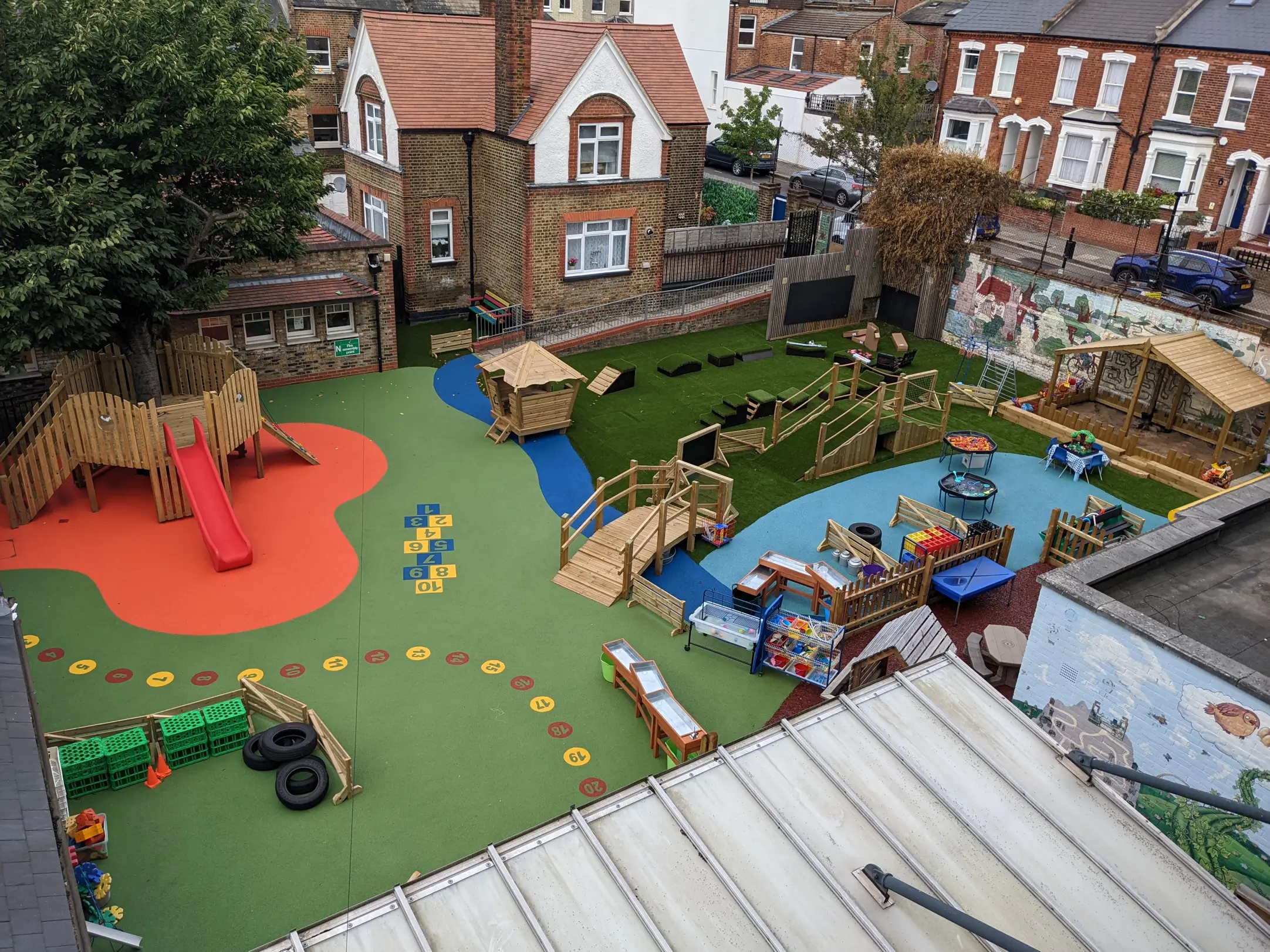
A calm, quiet space is a sheltered outdoor retreat, a pod, den or planted nook, where a child can step away from noise and bustle to settle, breathe and self-regulate.
View calm & quiet spaces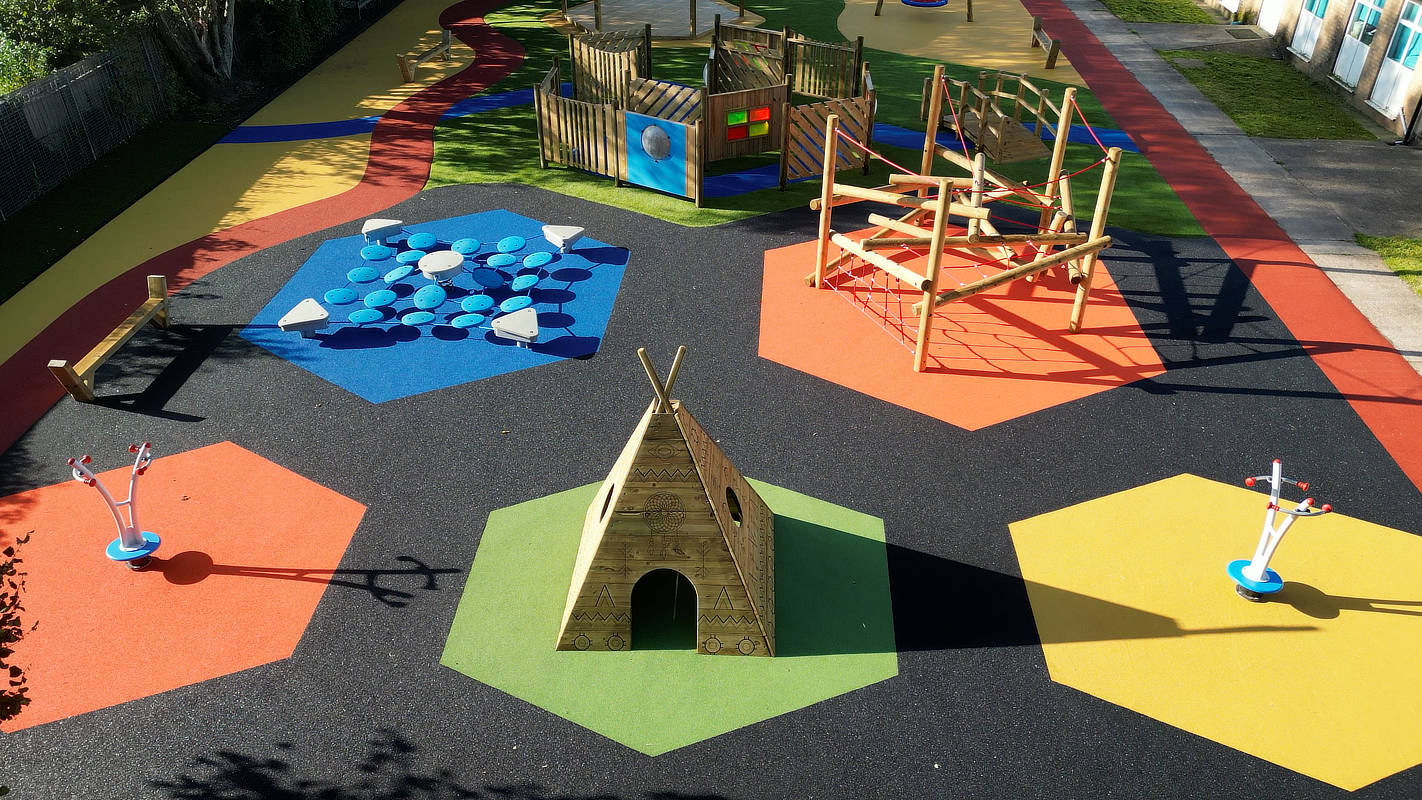
Autism-friendly playground design shapes the whole space around predictability and choice, with clear zones, calm retreats and considered sensory input, so play feels safe rather than overwhelming.
View autism-friendly playThis guide explains what makes play genuinely inclusive beyond the legal minimum, from step-free routes and transfer-friendly equipment to sensory variety and quiet spaces, and how we design to it.
View accessibility standardsBook a free site visit and we'll measure up, recommend the right surface and send a clear, fixed quote.