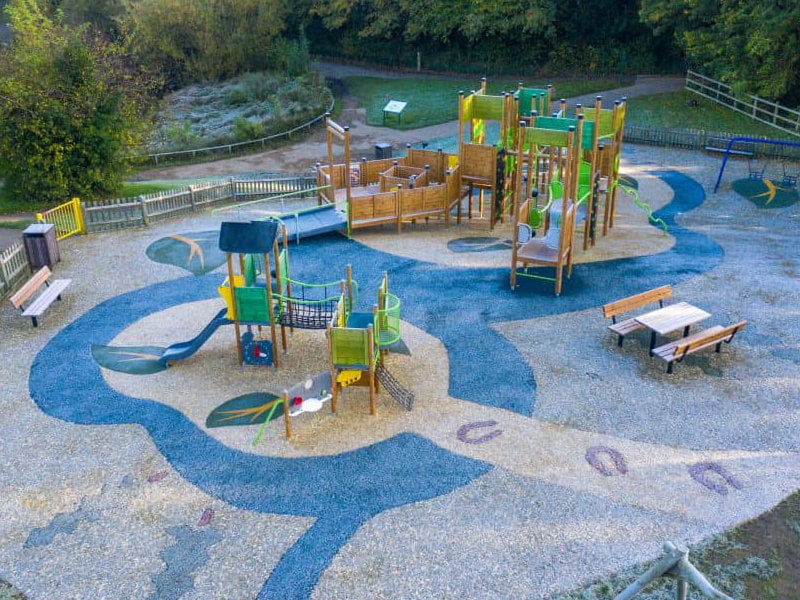
Rubber Mulch
Rubber mulch is a natural, bark-effect safety surface made from bonded recycled rubber: porous, low-maintenance and a cost-effective way to hit high fall-height ratings, especially on trails and forest-school areas.
View rubber mulchWet pour is the continuous, poured-in-place rubber surface you see in most modern playgrounds: smooth, colourful, wheelchair-friendly and specified to the exact fall height your equipment needs.
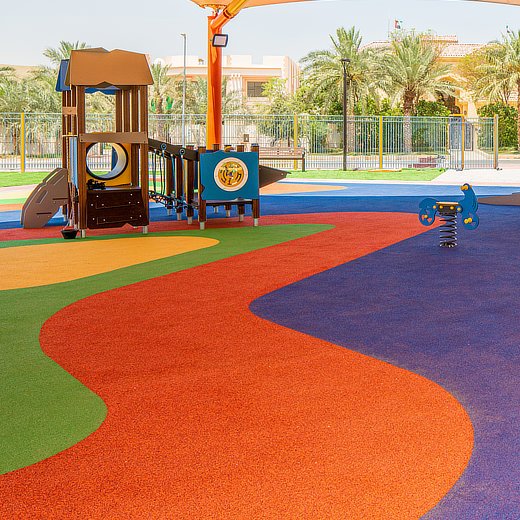
Wet pour rubber safety surfacing is a two-layer, poured-in-place rubber surface, tested to BS EN 1177, that we mix and trowel on site into a jointless finish. A shock-absorbing base of recycled SBR rubber granules carries a coloured wearing course of EPDM granules, both bound with polyurethane resin over a compacted MOT Type 1 sub-base.
Because the base-layer depth sets the Critical Fall Height, we specify wet pour to protect equipment of almost any height, from low toddler units to climbing towers up to 3m. It is the most common school and nursery playground surface because it is impact-tested, wheelchair-friendly and made-to-measure in any colour.
We install wet pour rubber safety surfacing as a layered build over a compacted MOT Type 1 stone sub-base, working to BS EN 1176 for the equipment and BS EN 1177 for the surface. We excavate and compact the sub-base, add a permeable membrane where needed, then lay the SBR shock base to the depth the Critical Fall Height demands.
On top of that base we trowel the coloured EPDM wearing course, roughly 15 to 20mm thick, and let the polyurethane binder cure before the area reopens, usually within 24 to 48 hours. We mix the SBR base and EPDM top on site, so we can build number grids, hopscotch, roadways or a school logo straight into the continuous surface as we lay it.
Wet pour rubber safety surfacing suits early-years and nursery areas, the ground under and around fixed play equipment, daily-mile trails, and any route where wheelchairs, walking frames or buggies need a smooth, level finish. Its jointless, slip-resistant surface reaches Critical Fall Heights up to 3m, which covers most school playground equipment.
We steer schools towards wet pour where a clean, colourful, step-free finish matters, particularly for SEN and EYFS settings. Colours and inlaid designs are mixed on site, so number grids, roadways, hopscotch and school logos go straight into the surface. Where a quicker or easily-repairable install suits the site, pre-formed rubber safety tiles are a practical alternative we also fit; compare the natural-look option in our rubber mulch range.
Wet pour rubber safety surfacing costs around 29 to 90 pounds per square metre installed, with multi-colour graphics reaching roughly 70 to 100 pounds per square metre. These are indicative UK ranges to confirm at survey, not fixed prices: plain black sits at the lower end, while the EPDM colour, the fall-height depth and the SBR base depth all move the figure.
Your final cost is driven by the area, the thickness set by the Critical Fall Height, the condition of the existing base and site access. New MOT Type 1 groundworks typically add around 18 to 30 pounds per square metre, though laying over sound existing tarmac or macadam saves that. For a firm number, get a wet pour surfacing quote and we will price your exact site.
| Specification | Wet pour rubber | Detail |
|---|---|---|
| Typical thickness | 15mm to 100mm+ | EPDM top of about 15 to 20mm over a deeper SBR shock base |
| Critical Fall Height | Up to 3m | Base depth set to the equipment's free height of fall |
| Indicative cost / m² | £29 to £90 (graphics £70 to £100) | Installed; sub-base prep adds about £18 to £30 |
| Lifespan | 8 to 12 years+ | 10 to 15 years with routine maintenance |
| Best for | Colourful, level, wheelchair-friendly areas and markings | Early-years, SEN, EYFS and equipment bays |
Indicative UK market ranges to confirm against your own pricing at survey. Thickness and cost depend on the Critical Fall Height and site condition.
Wet pour rubber safety surfacing is governed by BS EN 1177, the impact-attenuation standard, while the play equipment above it is governed by BS EN 1176. The surface's Critical Fall Height must equal or exceed the free height of fall of the equipment, and safety surfacing is required wherever that free fall exceeds 0.6m, up to the 3m playground maximum.
BS EN 1177 is proven by a drop test using a headform: wet pour passes only when it returns a Head Injury Criterion (HIC) below 1000 and a Gmax, the peak deceleration, below 200g. The safety zone must also extend around the equipment, typically at least 1.5m around static items and about 1.75m to the front and back of swings. We specify and test to these, and can arrange independent RPII or RoSPA inspection where you want it signed off.
Wet pour rubber safety surfacing thickness is set by the Critical Fall Height it must protect, so we measure the tallest equipment above it and deepen the SBR shock base to match while the EPDM wearing course stays at about 15 to 20mm. The total build runs from about 15mm over a hard base up to 100mm or more.
As an indicative guide, roughly 25mm covers a 0.6m fall, about 50mm covers a 1.5m fall, and around 100mm reaches the 3m playground maximum. The build is that coloured EPDM top over a deeper SBR granule base, both bound with polyurethane resin and sitting on the compacted MOT Type 1 sub-base. Not sure what your equipment needs? Book a free site survey and we will work it out.
Wet pour rubber safety surfacing typically lasts 8 to 12 years with routine care, and 10 to 15 years where it is well maintained and laid with a UV-stable binder. A UV-stable aliphatic polyurethane binder holds the EPDM colour through frost and sun, where a cheaper aromatic binder would fade sooner.
We patch and resurface worn or damaged areas rather than rip and replace, which extends the life of the surface you already have. Regular brushing and clearing of leaves keeps the wearing course porous and slip-resistant; see our playground surfacing range for how wet pour compares with the other systems over their life.
Wet pour rubber safety surfacing protects children by absorbing the impact of a fall, proven with a BS EN 1177 headform drop test to a HIC below 1000. A good porous system does three more things well: it drains straight through the wearing course and permeable sub-base, it holds its colour through the seasons, and it gives step-free access.
Because it is fully porous, water drains through into the ground so there are no puddles, which suits Sustainable Urban Drainage (SUDS) and lets play resume minutes after rain. A jointless, level finish stays step-free for wheelchairs and buggies, with no lips or trip edges between zones, which matters for SEN and EYFS settings. Any colour, plus markings, graphics and logos, is mixed into the surface itself.
Commercial Play designs, supplies and installs wet pour rubber safety surfacing in-house across England and Wales, so one team owns the job from survey to handover. We survey each site, work out the Critical Fall Height your equipment needs, and specify the EPDM top, SBR base depth and MOT Type 1 sub-base to match, not a one-size template.
We fit every major surface, so our recommendation follows your site rather than the one product we happen to sell, and we also repair and refresh worn wet pour instead of defaulting to full replacement. Compare wet pour with rubber mulch and artificial grass, or talk to us about your play area and we will tell you honestly what it needs.
Indicatively, wet pour rubber costs around 29 to 90 pounds per square metre installed, with multi-colour graphics reaching roughly 70 to 100 pounds. Sub-base prep adds about 18 to 30 pounds where new MOT Type 1 groundworks are needed. These are UK market ranges to confirm at survey, as area, fall height and access all move the figure.
A professionally installed wet pour surface typically lasts 8 to 12 years with routine care, and 10 to 15 years where it is well maintained with a UV-stable binder. Colours are UV-stable, and worn or damaged areas can be patched or resurfaced to extend its life rather than replaced.
Wet pour runs from about 15mm up to 100mm or more, set by the Critical Fall Height. As a guide, roughly 25mm suits a 0.6m fall and about 100mm suits the 3m maximum, built as an EPDM wearing course of about 15 to 20mm over a deeper SBR shock base bound with polyurethane resin.
Yes, in most cases. Sound tarmac or concrete makes an ideal base and laying straight over it reduces groundworks and cost. If the existing surface is cracked or uneven we will advise on repairs or a new MOT Type 1 sub-base first, which we check on survey.
Yes. Wet pour has a textured, slip-resistant finish and absorbs impact to a BS EN 1177 headform drop test, returning a HIC below 1000 and a Gmax below 200g. That is why it is the standard surface for school and nursery play areas.
Wet pour is a two-layer system: a shock-absorbing base of recycled SBR rubber granules and a coloured wearing course of EPDM granules, both bound with polyurethane resin and laid over a compacted MOT Type 1 sub-base. The SBR base depth sets the Critical Fall Height.
The polyurethane binder needs to cure before the area reopens, usually within 24 to 48 hours depending on temperature and humidity. We mix and lay the surface on site and confirm the reopening time with you as part of the install programme.
Wet pour reaches Critical Fall Heights up to the 3m playground maximum when laid to the right depth. We measure the free height of fall of your tallest equipment first, then build the SBR base up to match, tested to BS EN 1177 so the impact protection is measured, not assumed.
Part of our full playground surfacing range, explore the other surfaces below.
Rubber mulch is a natural, bark-effect safety surface made from bonded recycled rubber: porous, low-maintenance and a cost-effective way to hit high fall-height ratings, especially on trails and forest-school areas.
View rubber mulch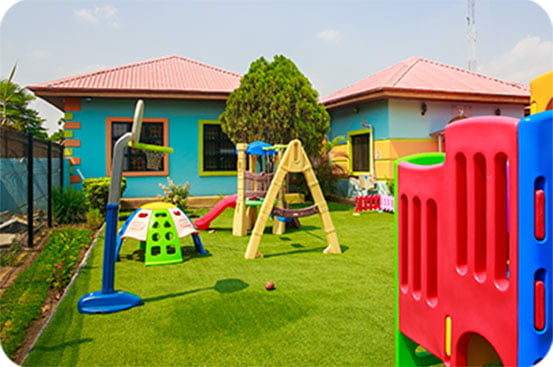
Artificial grass gives play areas a green, all-weather finish with no mud, mowing or standing water. Laid over a shockpad, it doubles as impact-absorbing safety surfacing tested to BS EN 1177.
View artificial grass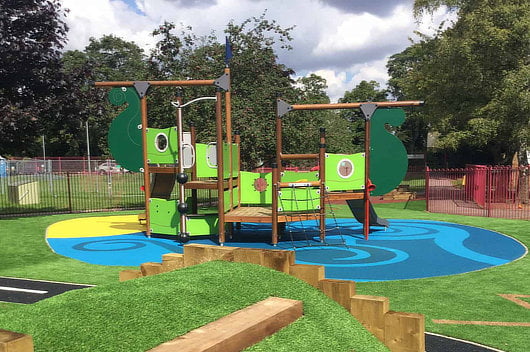
Grass mats are rubber safety tiles laid into natural grass: the grass grows through for a natural look, while the mats give firm, fall-safe, mud-free footing under swings, slides and gateways.
View grass matsBook a free site visit and we'll measure up, recommend the right surface and send a clear, fixed quote.