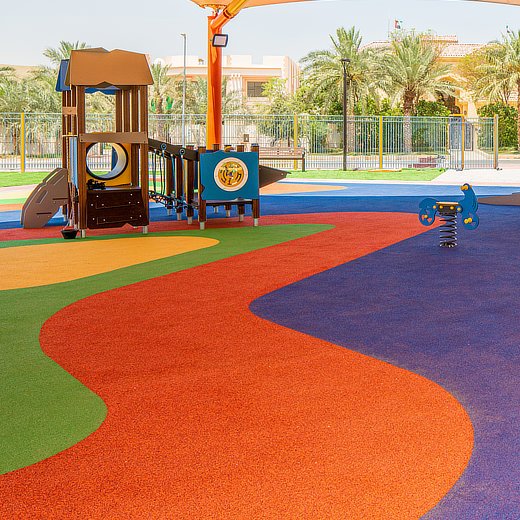
Wet Pour Rubber
Wet pour is the continuous, poured-in-place rubber surface you see in most modern playgrounds: smooth, colourful, wheelchair-friendly and specified to the exact fall height your equipment needs.
View wet pour rubberArtificial grass gives play areas a green, all-weather finish with no mud, mowing or standing water. Laid over a shockpad, it doubles as impact-absorbing safety surfacing tested to BS EN 1177.
Artificial grass for playgrounds is a synthetic turf carpet of monofilament polyethylene fibres, laid over a shockpad so it doubles as impact-absorbing safety surfacing tested to BS EN 1177. We install it as a system: a compacted MOT Type 1 sub-base, a foam or rubber shockpad set to the fall height, then the turf itself pinned and jointed on top.
Modern playground turf carries a pile height of around 28mm to 30mm and a face weight near 55 ounces, so it looks and feels close to natural grass while staying green and usable all year. Unlike a real lawn it does not churn to mud, need mowing or hold puddles, which is why early-years gardens and MUGAs reach for it.
We install artificial grass for playgrounds as a layered build over a compacted MOT Type 1 stone sub-base, not turf rolled straight onto soil. We excavate and level the ground, lay a weed membrane, add the shockpad set to the Critical Fall Height, then roll out the polyethylene turf, joint the seams and pin the perimeter so the finish is continuous with no lifting edges.
A kiln-dried sand infill is brushed into the pile to weigh the turf down and keep the fibres upright, and the porous backing drains rainfall straight through into the sub-base. Where the area sits under play equipment the shockpad thickness is measured to the fall height above it; where it is a plain play lawn we lay the turf without a pad for a hard-wearing, mud-free finish. We work to BS EN 1176 for the equipment and BS EN 1177 for the surface throughout.
Artificial grass for playgrounds is used wherever natural grass gets churned to mud: early-years and nursery gardens, trim-trail runs, general play lawns, and multi-use games areas (MUGAs). Over a shockpad it protects equipment to a tested Critical Fall Height; without one it makes a soft, natural-looking play lawn that stays usable through winter.
It pairs with other surfaces across a scheme, so we mix textures by zone: continuous wet pour for colourful equipment bays, and reinforced grass mats where you want real grass to grow through in gateways and goalmouths. For 2G and 3G sports turf on a full pitch, see our multi-use games area surfacing within the wider playground surfacing range.
A CFH-tested artificial grass and shockpad system costs around 45 to 85 pounds per square metre installed, with the shockpad alone from roughly 15 pounds per square metre and softer play-grade turf from about 19 to 20 pounds per square metre supply. These are indicative UK ranges to confirm at survey, not fixed prices: a plain play lawn with no pad sits at the lower end, while a deeper shockpad for a high fall height moves the figure up.
Your final cost is driven by the turf grade, the shockpad thickness set by the Critical Fall Height, the area, the condition of the existing base and site access. Sub-base preparation typically adds around 18 to 30 pounds per square metre where new MOT Type 1 groundworks are needed, though laying over sound existing tarmac or a level base can save that. For a firm number, get an artificial grass quote and we will price your exact site.
| System | Shockpad thickness | Critical Fall Height | Indicative cost / m² installed | Lifespan |
|---|---|---|---|---|
| Play lawn (no shockpad) | None | Not fall-rated | £20 to £45 | 8 to 15 years |
| Turf over 40mm shockpad | 40mm | Up to ~1.0 to 1.2m | £45 to £60 | 8 to 15 years |
| Turf over 50mm shockpad | 50mm | Up to ~1.5 to 1.8m | £55 to £70 | 8 to 15 years |
| Turf over 65mm to 80mm shockpad | 65mm to 80mm | Up to ~2.5 to 3.0m | £70 to £85 | 8 to 15 years |
Indicative UK market ranges to confirm against your own pricing at survey. Critical Fall Height is set by the shockpad and verified by a BS EN 1177 drop test for the tallest equipment above the surface.
Artificial grass over a shockpad is governed by BS EN 1177, the impact-attenuation standard, while the play equipment above it is governed by BS EN 1176. The surface passes only when a headform drop test returns a Head Injury Criterion (HIC) below 1000 and a Gmax, the peak deceleration, below 200g, and its Critical Fall Height must equal or exceed the free height of fall of the equipment above.
Safety surfacing is required wherever that free fall exceeds 0.6m, up to the 3m playground maximum, and the safety zone must extend around the equipment, typically at least 1.5m around static items. We specify play-grade turf that is lead-free and PFAS-safe for areas where children play, and can arrange independent RPII or RoSPA inspection where you want the finished area signed off.
Playground artificial grass uses a monofilament polyethylene (PE) yarn tufted to a pile height of around 28mm to 30mm and a face weight near 55 ounces, which gives the soft feel and the wear resistance a busy school area needs. The higher the face weight, the more hard-wearing the pile under heavy foot traffic, so we grade the turf to how the space is used rather than fitting one house default.
Under the turf the shockpad thickness sets the fall protection: roughly 40mm covers up to about 1.0 to 1.2m, 50mm up to about 1.5 to 1.8m, and 65mm to 80mm up to about 2.5 to 3.0m. A kiln-dried sand infill keeps the fibres upright and the porous latex backing drains rain straight through, so we match yarn grade, pad depth and infill to your equipment, age groups and budget.
Artificial grass for playgrounds typically lasts 8 to 15 years with light maintenance, depending on how heavily the area is used and how well the sub-base drains. A properly compacted base and free-draining backing are the biggest factors in reaching the top of that band, which is why we build the groundworks to the same standard as the turf.
Upkeep is a periodic brush to lift the pile, a top-up of the sand infill where it settles, and a clear of leaves and debris, with no mowing, watering or reseeding. Worn patches and joints can be re-seamed or re-pinned rather than replacing the whole area, and we repair and refresh surfaces we have installed; see playground surfacing for the wider range we maintain.
Artificial grass for playgrounds protects children by absorbing the impact of a fall when laid over a shockpad, proven with a BS EN 1177 headform drop test. A good system does three more things well: it drains through a porous backing and permeable sub-base, it stays green and mud-free through every season, and it gives a soft, level surface underfoot for early-years play.
The porous latex backing and permeable sub-base let rain drain straight through, so there are no puddles and play can resume soon after rain, which suits Sustainable Urban Drainage (SUDS). The polyethylene pile holds its colour through frost and sun with no mowing, watering or reseeding, and a level turf finish stays step-free for wheelchairs and buggies, which matters for SEN and EYFS settings.
Commercial Play designs, supplies and installs artificial grass for playgrounds in-house across England and Wales, so one team owns the job from survey to handover. We survey each site, work out the Critical Fall Height your equipment needs, and specify the turf grade, shockpad thickness and MOT Type 1 sub-base to match, not a one-size template.
We fit the full surfacing range, so our recommendation follows your site rather than the one product we happen to sell, and we can mix continuous wet pour, reinforced grass mats and artificial grass across a scheme to give each zone the right surface. Talk to us about your play area and we will tell you honestly what it needs.
Yes. When laid over an impact-absorbing shockpad, artificial grass is tested to BS EN 1177, passing only when the drop test returns a Head Injury Criterion below 1000 and a Gmax below 200g for the fall height above it. Play-grade turf is non-toxic, lead-free and free-draining, giving a soft, even surface for play.
Indicatively, a CFH-tested turf and shockpad system runs around 45 to 85 pounds per square metre installed, with the shockpad alone from roughly 15 pounds and a plain play lawn from about 20 pounds. Sub-base preparation adds roughly 18 to 30 pounds where new groundworks are needed. These are market ranges to confirm at a site survey, as area, fall height and access all move the figure.
The shockpad thickness is set by the Critical Fall Height of the equipment above. As a guide, roughly 40mm covers up to about 1.0 to 1.2m, 50mm up to about 1.5 to 1.8m, and 65mm to 80mm up to about 2.5 to 3.0m, verified by a BS EN 1177 drop test. Without a shockpad the turf makes a play lawn but is not fall-rated.
No. A porous latex backing and free-draining sub-base let water pass straight through, so, unlike natural grass, it does not turn to mud or hold puddles. That free drainage suits Sustainable Urban Drainage and lets play resume soon after rain.
Play-grade artificial grass typically lasts 8 to 15 years with light maintenance, depending on how heavily the area is used and how well the sub-base drains. Worn patches and joints can be re-seamed or re-pinned without replacing the whole area.
Upkeep is a periodic brush to lift the pile, a top-up of the kiln-dried sand infill where it settles, and a clear of leaves and debris, with no mowing, watering or reseeding. We check the seams and pinned edges and repair small issues as they appear so they do not spread.
We fit a monofilament polyethylene turf with a pile height of around 28mm to 30mm and a face weight near 55 ounces, graded to how the space is used, with a kiln-dried sand infill. It is lead-free and PFAS-safe for areas where children play, and we set the shockpad depth beneath it to the Critical Fall Height your equipment needs.
Yes. Specialist sports turf and 2G or 3G surfaces are designed for multi-use games areas and pitches, set out to the correct dimensions and infilled for reliable year-round play. For play lawns and early-years gardens we fit softer play-grade turf, so we specify the grade by how the surface will be used.
Yes, where the existing base is sound and level we can lay the shockpad and turf straight over it, which reduces groundworks and cost. We check the base on survey first, as a failing sub-base needs repair before any surfacing goes down, otherwise drainage and the finish suffer.
Part of our full playground surfacing range, explore the other surfaces below.
Wet pour is the continuous, poured-in-place rubber surface you see in most modern playgrounds: smooth, colourful, wheelchair-friendly and specified to the exact fall height your equipment needs.
View wet pour rubber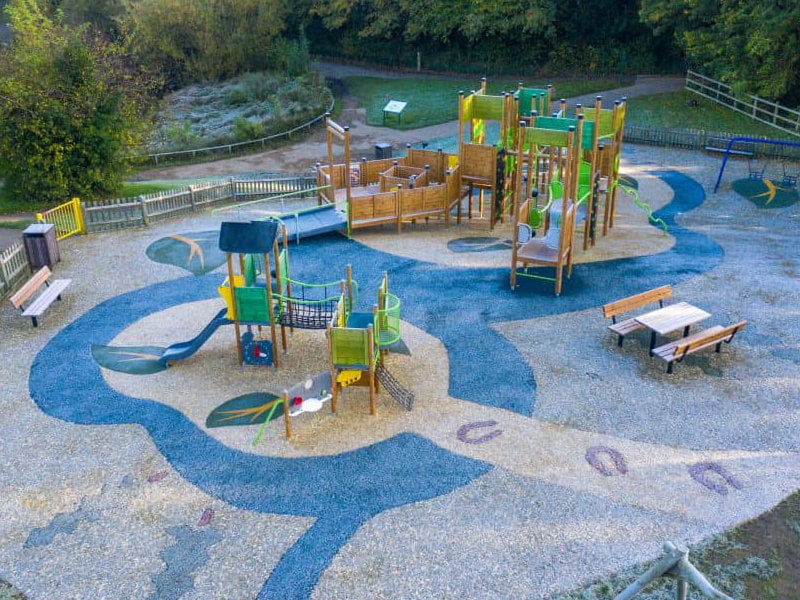
Rubber mulch is a natural, bark-effect safety surface made from bonded recycled rubber: porous, low-maintenance and a cost-effective way to hit high fall-height ratings, especially on trails and forest-school areas.
View rubber mulch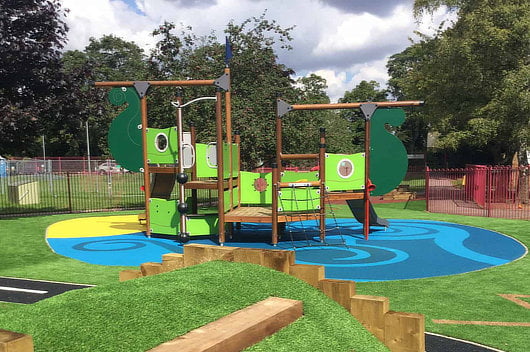
Grass mats are rubber safety tiles laid into natural grass: the grass grows through for a natural look, while the mats give firm, fall-safe, mud-free footing under swings, slides and gateways.
View grass matsBook a free site visit and we'll measure up, recommend the right surface and send a clear, fixed quote.