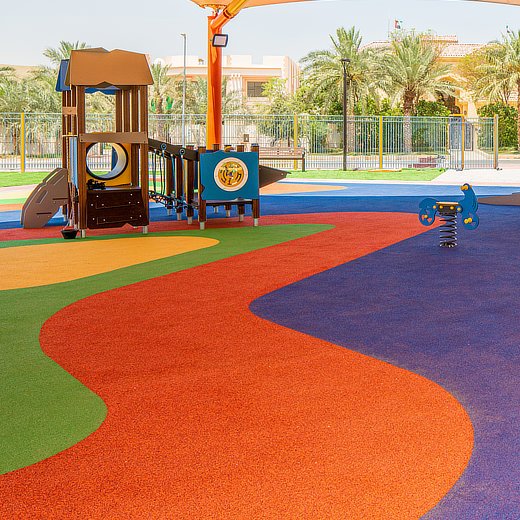
Wet Pour Rubber
Wet pour is the continuous, poured-in-place rubber surface you see in most modern playgrounds: smooth, colourful, wheelchair-friendly and specified to the exact fall height your equipment needs.
View wet pour rubberGrass mats are rubber safety tiles laid into natural grass: the grass grows through for a natural look, while the mats give firm, fall-safe, mud-free footing under swings, slides and gateways.
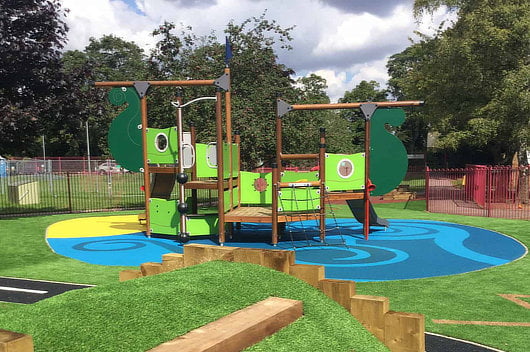
Grass mats are perforated rubber safety tiles, sized 1m by 1.5m, pinned into an existing lawn so grass grows up through the holes for a natural green finish over firm, fall-safe footing. We lay them across the high-wear zones where natural grass fails: swing bays, slide exits, gateways, goalmouths and busy desire lines across a field.
Each mat is made from recycled SBR rubber granules bound into a hard-wearing tile, carrying 25mm drainage holes that let grass knit through within a few weeks in the growing season. Rather than a continuous poured surface, this is a reinforcement layer that spreads load, stops turf wearing to mud, and adds impact protection tested to BS EN 1177 while the area still reads as a lawn.
Grass mats work by spreading foot and equipment load across a perforated rubber tile, so the turf beneath survives instead of compacting to bare mud, while grass grows up through the 25mm holes to knit the mat into the lawn. The recycled SBR rubber compresses on impact and recovers, which gives the tile its fall-absorbing behaviour under swings and slides.
The holes do two jobs at once: they drain rainwater straight through to the ground rather than pooling, and they let the roots and grass leaf tie the mat into the surface so it stops reading as matting after a few weeks. On level ground each mat's own 25 to 35kg weight adds stability, and we pin every tile so it holds under daily use. Where a fully synthetic finish is wanted instead, we fit artificial grass over a shock pad.
We install grass mats over prepared existing grass, cutting the turf short, clearing clippings and debris, then levelling hollows with sandy topsoil before laying the 1m by 1.5m tiles tight-butted edge to edge. There is no excavation or resin curing, so the reinforced zone is usable almost straight away rather than fenced off for days.
Each tile is fixed with five pegs, one at each corner and one in the middle, and cable ties join neighbouring mats into a single stable field. On existing grass we use plastic pegs that slot through the mat holes, and we reinforce only the worn zones rather than the whole area, which keeps the natural look and the cost down.
Grass mats are used by schools, nurseries and public play areas wherever natural grass takes concentrated wear: under swings and slides, around gates and goalmouths, along muddy paths and at the base of trim trails and climbers. They suit any setting that wants to keep a green, natural look rather than convert to a hard or coloured surface.
They are the answer for early-years and forest-school grounds where a lawn finish matters, and for grounds staff fighting the same bare, muddy patches every winter. For a continuous coloured surface with markings we fit wet pour instead, and grass mats sit alongside the other options across our playground surfacing range.
Grass mats cost around 35 to 90 pounds per square metre supplied and installed, with the 23mm playground-grade tile at the upper end and the thinner 16mm mat lower. These are indicative UK ranges to confirm at survey, not fixed prices: the mat thickness, the area, ground levelling and access all move the figure.
Reinforcing only the worn zones, rather than resurfacing a whole field, is what makes grass mats a cost-effective fix, and installing over sound existing grass avoids the groundworks a poured surface needs. For a firm number, get a grass mats quote and we will price your exact site.
| Mat option | Tile size | Thickness | Critical Fall Height | Indicative cost / m | Lifespan |
|---|---|---|---|---|---|
| Standard grass mat | 1m x 1.5m | 16mm | Around 1.0m | £35 to £55 | 10 to 15 years |
| Playground grass mat | 1m x 1.5m | 23mm | Up to about 3m | £55 to £90 | 10 to 15 years |
Indicative UK market ranges to confirm against your own pricing at a site survey. Critical Fall Height is set by the mat and must match the equipment above it.
Grass mats used under play equipment are tested to BS EN 1177, the impact-attenuation standard, while the equipment above them stays governed by BS EN 1176. The 23mm playground tile is certified to BS EN 1177 with a Critical Fall Height of around 3m, and the mat's rating must equal or exceed the free height of fall of the equipment above it.
BS EN 1177 is proven by a headform drop test that the surface passes only when it returns a Head Injury Criterion below 1000 and a Gmax below 200g. Safety surfacing is required wherever the free fall exceeds 0.6m, so we match the mat thickness to your equipment and can arrange independent RPII or RoSPA inspection where you want it signed off.
Grass mats come as 1m by 1.5m tiles in 16mm and 23mm thicknesses, and the thickness is set by the Critical Fall Height it must protect. The 16mm mat suits paths, gateways and ground reinforcement at low fall heights of around 1m, while the 23mm mat is the playground-grade tile rated to a Critical Fall Height of up to about 3m under swings, slides and climbers.
We measure the tallest equipment above the mat first, then specify 16mm or 23mm to match, because a mat too thin for the equipment fails the fall height it needs to cover. Each tile carries 25mm holes for grass and drainage, and weighs roughly 25 to 35kg, so it stays put once pegged. Not sure which you need? Book a free site survey and we will work it out.
Grass mats last 10 to 15 years with routine care, and the recycled SBR rubber tile holds its shape and impact rating across that life rather than rotting or blowing away. Once the grass has grown through, the lawn hides and protects the mat, which helps it weather British winters and summers.
Unlike loose bark or wood chip, which decompose and need topping up every year, a pegged rubber grass mat stays in place and keeps its Critical Fall Height. We also lift, re-level and re-peg mats where ground moves rather than replacing them, extending the life of what is already down.
Grass mats protect children by absorbing the impact of a fall, tested to BS EN 1177, while keeping a natural lawn finish that a hard or coloured surface cannot. A good mat does three more things well: grass grows up through the 25mm holes so the area still looks like grass, the tile spreads load so the turf stops wearing to mud, and the perforations drain rainwater straight through with no puddles.
The install is targeted and quick: we reinforce only the worn zones over sound existing grass, with no excavation or resin curing, so an area is usable almost straight away and the budget goes further than resurfacing a whole field. Made from recycled SBR rubber, each tile also carries a recycled-content benefit, and once knitted into the lawn it gives firm, mud-free, fall-safe footing that lasts 10 to 15 years.
Commercial Play designs, supplies and installs grass mats in-house across England and Wales, so one team owns the job from survey to handover. We measure the Critical Fall Height your equipment needs, specify 16mm or 23mm tiles to match, and prepare the existing grass before pinning so the mats hold and the lawn grows through cleanly.
We fit every surface in the range, so our recommendation follows your site rather than the one product we happen to sell: grass mats where a natural finish matters, fully synthetic artificial grass where mud-free all-year play is the priority, and continuous wet pour where you want colour and markings. Talk to us about your play area and we will tell you honestly what it needs.
Grass mats reinforce natural grass in high-wear areas such as under swings and slides, around gates and goalmouths, and on muddy paths. They stop the grass turning to mud while keeping a natural look and adding fall protection tested to BS EN 1177.
Yes. Rubber grass mats are impact-absorbing and tested to BS EN 1177. The 23mm playground tile is rated to a Critical Fall Height of up to about 3m, and we match the mat thickness to the height of the equipment above it.
Yes. The mats carry 25mm perforations, so grass grows up through them and knits them into the lawn for a natural appearance, usually within a few weeks in the growing season.
Grass mats come as 1m by 1.5m tiles in 16mm and 23mm thicknesses. The 16mm mat suits paths and low fall heights of around 1m, while the 23mm mat is the playground-grade tile rated to a Critical Fall Height of up to about 3m.
Indicatively, grass mats cost around 35 to 90 pounds per square metre supplied and installed, with the 23mm playground tile at the upper end and the 16mm mat lower. These are market ranges to confirm at a site survey, as thickness, area and access all move the figure.
Each 1m by 1.5m tile is fixed with five pegs, one at each corner and one in the middle, with cable ties joining neighbouring mats into a single stable field. On existing grass we use plastic pegs that slot through the mat holes, and each mat's own 25 to 35kg weight adds stability.
They serve different needs. Grass mats keep a real-grass look and reinforce specific worn areas, while artificial grass replaces the grass entirely for an all-weather green finish. We fit both and advise which suits each part of your grounds.
Grass mats last 10 to 15 years with routine care. The recycled SBR rubber tile holds its shape and impact rating without rotting or blowing away, and once the grass grows through, the lawn protects the mat further.
Yes. We cut the turf short, clear debris and level any hollows with sandy topsoil, then lay and peg the tiles straight onto the prepared grass. There is no excavation or resin curing, so the area is usable almost straight away.
Part of our full playground surfacing range, explore the other surfaces below.
Wet pour is the continuous, poured-in-place rubber surface you see in most modern playgrounds: smooth, colourful, wheelchair-friendly and specified to the exact fall height your equipment needs.
View wet pour rubber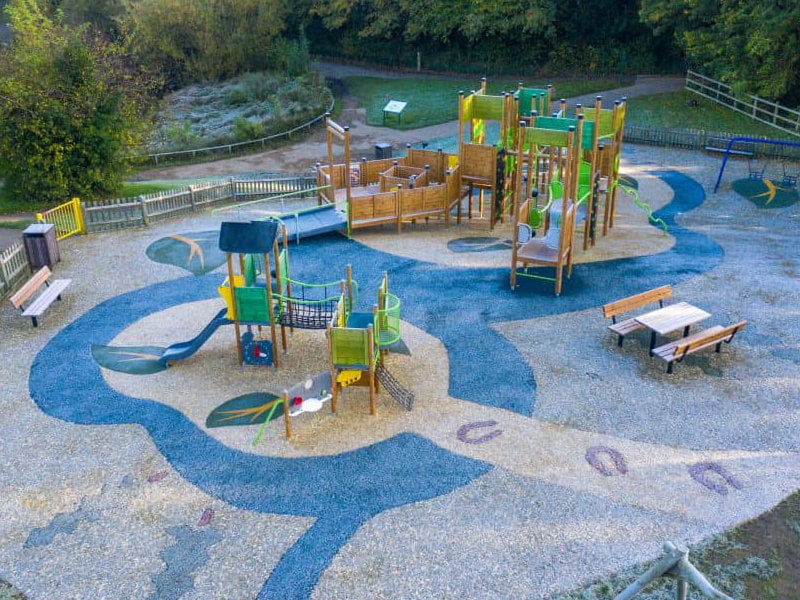
Rubber mulch is a natural, bark-effect safety surface made from bonded recycled rubber: porous, low-maintenance and a cost-effective way to hit high fall-height ratings, especially on trails and forest-school areas.
View rubber mulch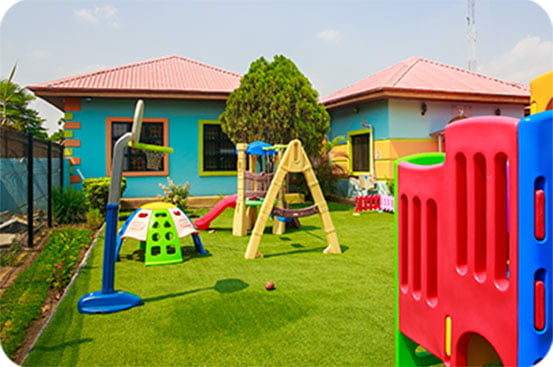
Artificial grass gives play areas a green, all-weather finish with no mud, mowing or standing water. Laid over a shockpad, it doubles as impact-absorbing safety surfacing tested to BS EN 1177.
View artificial grassBook a free site visit and we'll measure up, recommend the right surface and send a clear, fixed quote.