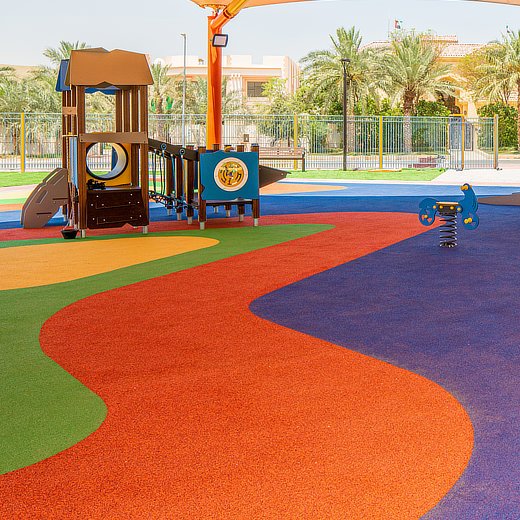
Wet Pour Rubber
Wet pour is the continuous, poured-in-place rubber surface you see in most modern playgrounds: smooth, colourful, wheelchair-friendly and specified to the exact fall height your equipment needs.
View wet pour rubberRubber mulch is a natural, bark-effect safety surface made from bonded recycled rubber: porous, low-maintenance and a cost-effective way to hit high fall-height ratings, especially on trails and forest-school areas.
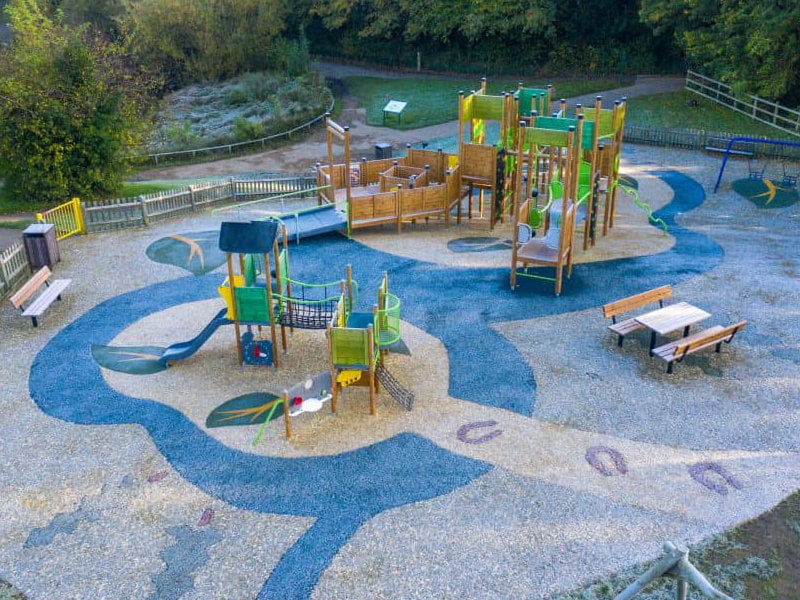
Rubber mulch playground surfacing is a bark-effect safety surface made from shredded recycled tyre rubber bound with polyurethane resin and laid as a continuous, porous layer tested to BS EN 1177. We trowel it on site over a geotextile membrane so it gives the woodland look of loose bark chippings without the rot, scatter or splinters.
Unlike loose bark, bonded rubber mulch does not decay, blow away or need topping up, and it holds a consistent Critical Fall Height as it wears. It suits playground surfacing schemes on trim trails, tree surrounds and forest-school areas, and pairs well with wet pour for equipment bays and pathways.
Rubber mulch playground surfacing is made from shredded recycled tyre rubber mixed with a clear polyurethane binder at roughly a 5 to 1 ratio, then levelled and rolled on site into a continuous surface at a minimum 50mm finished depth. We lay it over a geotextile membrane on a prepared sub-base, following the contours of the ground for a natural finish.
We install it directly onto sound, well-drained grass or soil with the membrane underlay, or over existing tarmac and macadam where the base is level and holding, which cuts the groundworks and the cost that comes with them. Each layer is built up to the Critical Fall Height the equipment needs, working to BS EN 1176 for the equipment above and BS EN 1177 for the surface itself.
Rubber mulch playground surfacing is used under taller equipment and along nature trails where a natural bark look matters and fall heights reach up to 3m, so we specify it for trim trails, adventure areas, tree surrounds, forest-school zones and woodland-style settings. Its bark-effect finish blends into planted and green spaces where a coloured surface would look out of place.
We also combine it with wet pour for equipment bays and pathways, and with artificial grass across a mixed scheme, giving each zone the right surface. It works across schools, nurseries and public play parks throughout England and Wales.
Rubber mulch playground surfacing costs around 40 to 100 pounds per square metre installed, an indicative UK market range to confirm at survey rather than a fixed price. The depth set by the Critical Fall Height, the area, the colour blend and site access all move the figure, so we price your exact site.
Sub-base preparation typically adds around 18 to 30 pounds per square metre where new MOT Type 1 groundworks are needed, though laying over sound existing tarmac or well-drained grass with a geotextile membrane can save that. For a firm number, get a rubber mulch surfacing quote and we will price your play area against its equipment and fall heights.
| Rubber mulch depth | Critical Fall Height (indicative) | Suits equipment up to | Indicative cost / m² | Lifespan |
|---|---|---|---|---|
| 50mm | Up to about 1.6m | 1.5m towers and trim trails | £40 to £100 | 8 to 12 years+ |
| 75mm | Up to about 2.5m | Taller climbing frames | £40 to £100 | 8 to 12 years+ |
| 100mm+ | Up to 3m | Tall towers and adventure units | £40 to £100 | 8 to 12 years+ |
Indicative depth to Critical Fall Height guide and UK market cost ranges, confirmed against your equipment and our own pricing at a site survey. Higher fall heights are reached over a firmer sub-base.
Rubber mulch playground surfacing is governed by BS EN 1177, the impact-attenuation standard, while the equipment above it is governed by BS EN 1176. The surface Critical Fall Height must equal or exceed the free height of fall of that equipment, and safety surfacing is required wherever the free fall exceeds 0.6m, up to the 3m playground maximum.
BS EN 1177 is proven by a drop test using a headform: the surface passes only when it returns a Head Injury Criterion (HIC) below 1000 and a Gmax, the peak deceleration, below 200g. The safety zone must also extend around the equipment, typically at least 1.5m around static items. We specify and test to these, and can arrange independent RPII or RoSPA inspection where you want it signed off.
Rubber mulch playground surfacing depth is set by the Critical Fall Height it must protect, starting at a minimum 50mm finished thickness which gives an indicative fall height of about 1.6m. We measure the tallest equipment above it first, then build the bonded layer deeper to match, with 75mm reaching roughly 2.5m and 100mm or more up to the 3m playground maximum.
Higher fall heights are reached over a firmer sub-base, so the base condition and the equipment height both drive the specification. Because the surface is bonded rather than loose-fill, it holds that depth and its impact protection year after year instead of dispersing and thinning like loose bark. Not sure what your equipment needs? Book a free site survey and we will work it out.
Rubber mulch playground surfacing typically lasts 8 to 12 years with routine care, holding its Critical Fall Height and porous drainage across that life because the recycled rubber is bonded into a continuous surface rather than laid loose. Loose bark and wood chip, by contrast, rot and need topping up every year, which is one reason bonded rubber mulch often works out better over time.
Worn patches can be re-bonded or topped up in place without replacing the whole area, so we refresh a surface you already have rather than rip and replace; see playground surface repairs and maintenance. An occasional brush and a clear of leaves and debris is all the routine upkeep it needs.
Rubber mulch playground surfacing protects children by absorbing the impact of a fall, proven with a BS EN 1177 headform drop test to the Critical Fall Height of the equipment above. It gives the natural woodland look of bark without the decay, scatter or splinters, and being bonded it stays put rather than shifting underfoot.
It is fully porous and free-draining, so rain passes straight through and trails and play areas stay usable through the seasons with no puddles, which suits Sustainable Urban Drainage (SUDS). Made from shredded recycled tyre rubber, it carries a recycled-content and sustainability benefit that suits school environmental goals, and it needs far less maintenance than loose bark or wood chip.
Commercial Play designs, supplies and installs rubber mulch playground surfacing in-house across England and Wales, so one team owns the job from survey to handover. We survey each site, work out the Critical Fall Height your equipment needs, and specify the depth, geotextile membrane and sub-base to match, not a one-size template.
We fit all four surface types, so our recommendation follows your site rather than the one product we happen to sell, and we will steer you to wet pour where a level, colourful finish suits better. We also re-bond and refresh worn rubber mulch instead of defaulting to full replacement. Talk to us about your play area and we will tell you honestly what it needs.
For most schools, yes. Bonded rubber mulch keeps the natural bark look but does not rot, blow away or need annual topping up, stays porous, and holds a higher, more consistent Critical Fall Height over time, so it needs far less maintenance than loose bark or wood chip.
Indicatively, rubber mulch is around 40 to 100 pounds per square metre installed, with sub-base preparation adding roughly 18 to 30 pounds where new MOT Type 1 groundworks are needed. These are UK market ranges to confirm at a site survey, as depth, area, fall height and access all move the figure.
Rubber mulch is laid at a minimum 50mm finished depth, which gives an indicative Critical Fall Height of about 1.6m. We build it deeper to match taller equipment, with 75mm reaching roughly 2.5m and 100mm or more up to the 3m playground maximum, the exact depth set by the free height of fall above it.
A bonded rubber mulch surface typically lasts 8 to 12 years with routine care, holding its fall height and drainage because the rubber is bonded rather than loose. Worn patches can be re-bonded or topped up in place without replacing the whole area.
Yes. It is made from clean, processed recycled tyre rubber bound with polyurethane so there are no loose pieces, and it is laid to the depth needed to protect against falls to BS EN 1177, returning a Head Injury Criterion below 1000 and a peak deceleration below 200g on the drop test.
Yes. Rubber mulch can be installed over a geotextile membrane on sound, well-drained grass or soil, following the ground contours, or over existing tarmac and macadam where the base is level and holding. We check the base on survey first, as a failing sub-base needs repair before any surfacing goes down.
Yes. Bonded rubber mulch is fully porous, so rain drains straight through the surface and sub-base into the ground with no puddles, which suits Sustainable Urban Drainage and lets trails and play areas stay usable through the seasons.
Rubber mulch suits trim trails, adventure areas, tree surrounds, forest-school zones and woodland-style settings where a natural bark look matters and equipment reaches high fall heights up to 3m. We often combine it with wet pour for equipment bays and pathways across a mixed scheme.
Part of our full playground surfacing range, explore the other surfaces below.
Wet pour is the continuous, poured-in-place rubber surface you see in most modern playgrounds: smooth, colourful, wheelchair-friendly and specified to the exact fall height your equipment needs.
View wet pour rubber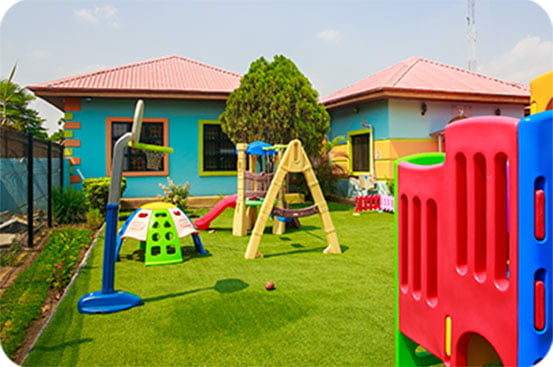
Artificial grass gives play areas a green, all-weather finish with no mud, mowing or standing water. Laid over a shockpad, it doubles as impact-absorbing safety surfacing tested to BS EN 1177.
View artificial grass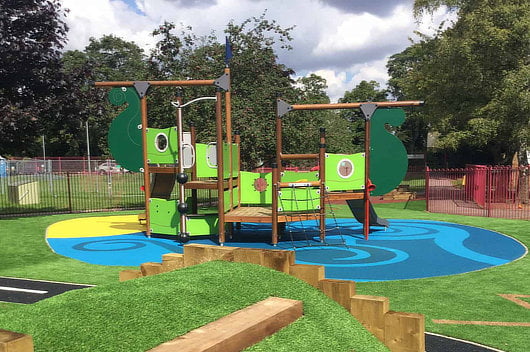
Grass mats are rubber safety tiles laid into natural grass: the grass grows through for a natural look, while the mats give firm, fall-safe, mud-free footing under swings, slides and gateways.
View grass matsBook a free site visit and we'll measure up, recommend the right surface and send a clear, fixed quote.