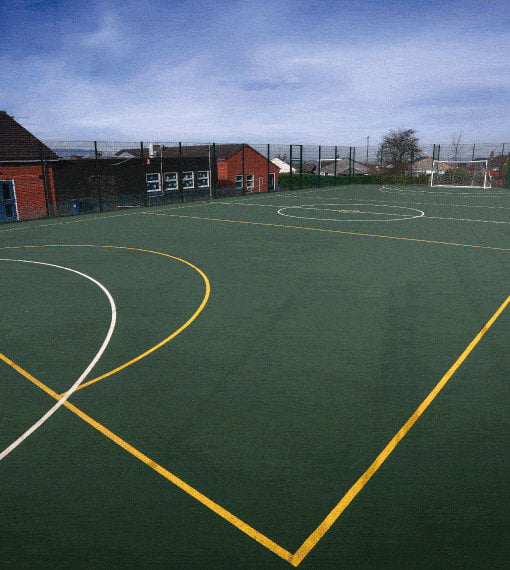
MUGA Pitches
A MUGA, Multi-Use Games Area, is a fenced, all-weather court line-marked for several sports at once, so one space hosts football, basketball, netball and tennis for PE, clubs and community hire.
View muga pitchesA trim trail is a route of physical challenges, balance beams, stepping logs, climbers and monkey bars, that builds fitness, balance and coordination while children think they are just playing.
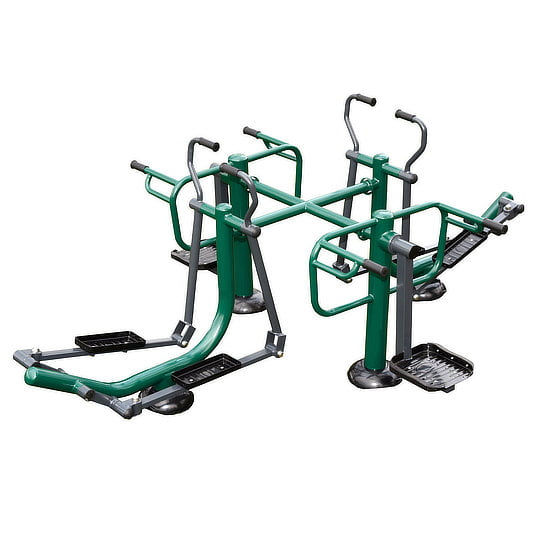
A trim trail is a route of physical-challenge stations, balance beams, wobble bridges, stepping logs, climbing frames, monkey bars and hurdles, arranged as a loop or line around the grounds and built to BS EN 1176. Children move from one obstacle to the next, building strength, balance, agility and coordination as they go.
Because it feels like play rather than exercise, a trim trail keeps active the children who would never choose competitive sport, and it feeds the physical-development and fitness strands of the curriculum. We lay every trail over impact-absorbing safety surfacing so a fall is protected to BS EN 1177.
A trim trail is built from pressure-treated timber, either Douglas fir or Robinia hardwood, or from galvanised steel, and set on concrete or galvanised steel-footing foundations over surfacing rated to BS EN 1177. We fix each station to its foundation, clear a fall-safe zone around it, and lay the surface up to the Critical Fall Height of the tallest challenge before the trail opens.
Steel footings under timber posts stop moisture wicking into the timber and add years to its life. On a larger site we route the trail as a loop so children flow between stations; on a tight site a compact combination unit packs balance, climb, swing and step into one footprint. We work to BS EN 1176 for the equipment and BS EN 1177 for the surface below it.
A trim trail is specified by age group across EYFS, KS1, KS2 and secondary, with the challenge type and height pitched to the children who use it. Low balance beams and stepping logs at a free fall height of 0.6m or less suit EYFS and KS1 and build early confidence, while taller climbing and swinging stations develop stamina and upper-body strength for KS2 and secondary pupils.
We install trails on grass, playground or field, and they combine well with an outdoor gym or a running track to build a full fitness circuit across the grounds. See the wider sports facilities range for the surrounding provision.
A trim trail costs around 3,000 to 25,000 pounds installed, set by the number of stations and the complexity of the route. A basic linear trail of 3 to 5 elements sits at roughly 3,000 to 6,000 pounds, a medium trail of 6 to 10 linked stations at around 8,000 to 15,000 pounds, and a large trail of 10 or more stations with full surfacing at about 18,000 to 25,000 pounds or more.
These are indicative UK ranges to confirm at survey, not fixed prices. The station count, the material (timber or steel), the fall height and the safety surfacing below all move the figure, and the surfacing is often the largest single line where a tall trail needs deep impact protection. For a firm number, get a trim trail quote and we will price your exact site.
The table below sets out the three trail sizes against station count, indicative cost and typical age fit.
| Trail size | Stations | Indicative cost installed | Typical age fit |
|---|---|---|---|
| Basic linear trail | 3 to 5 | £3,000 to £6,000 | EYFS and KS1 |
| Medium trail | 6 to 10 | £8,000 to £15,000 | KS1 and KS2 |
| Large trail or loop | 10 or more | £18,000 to £25,000+ | KS2 and secondary |
Indicative UK market ranges to confirm at a site survey. Safety surfacing to BS EN 1177 is priced separately by the fall height the trail needs to cover.
A trim trail is governed by BS EN 1176, the playground equipment safety standard, while the surfacing beneath it is governed by BS EN 1177, the impact-attenuation standard. The surface's Critical Fall Height must equal or exceed the free height of fall of the tallest station above it, and safety surfacing is required wherever that free fall exceeds 0.6m.
Low-level trails with a free fall height of 0.6m or under carry the lightest surfacing demand, while taller climbing and swinging stations push the fall height up and need deeper impact protection to pass. We specify and install to both standards, and can arrange an independent RPII or RoSPA inspection where you want the finished trail signed off.
A trim trail is made in pressure-treated timber, Douglas fir or Robinia hardwood, or in galvanised steel, sized by age group with a free fall height from 0.6m at low level up to about 2m on the tallest climbing stations. Timber gives a natural, woodland look that suits early-years and grounds settings; galvanised steel gives a harder-wearing frame for busy KS2 and secondary use.
Station types cover balance beams, wobble bridges, stepping logs and poles, climbing frames, monkey bars and hurdles, mixed so a trail has something to balance on, something to climb, something to swing from and something to jump. We size the run to your space, from a compact combination unit in a single footprint to a full loop around the field, and match every fall height to the surfacing below.
| Material | Look and feel | Free fall height range | Indicative lifespan | Best for |
|---|---|---|---|---|
| Pressure-treated timber (Douglas fir / Robinia) | Natural, woodland finish | 0.6m to about 2m | About 15 years | Early-years and natural grounds settings |
| Galvanised steel | Hard-wearing painted frame | 0.6m to about 2m | 20 to 30 years or more | Busy KS2 and secondary use |
Indicative material lifespans with routine care and inspection, to confirm at survey. Steel footings under timber posts extend timber life.
A timber trim trail lasts about 15 years with routine care, and a galvanised steel trail lasts 20 to 30 years or more, so material choice sets the service life more than any other factor. Pressure treatment, Robinia hardwood and steel footings under timber posts all push the timber figure towards the top of that band.
Life depends on inspection and small repairs kept on top of, not left to spread. We clear dirt and mulch from around galvanised feet so moisture cannot wick into the posts, and we repair worn stations and fixings rather than replace a whole trail. The safety surfacing below is on its own cycle, typically 8 to 12 years for bonded rubber; see playground repairs and maintenance.
A trim trail builds strength, balance, agility and coordination through active play tested to BS EN 1176, and it reaches the children who never choose competitive sport. Because the route feels like fun rather than exercise, participation stays high, which supports the physical-development and fitness strands of the curriculum.
A trail also uses ground a pitch cannot: it runs along an edge, wraps a field or packs into a single footprint as a combination unit, so it adds fitness provision without taking a court. It pitches to every key stage, from EYFS balance logs to secondary climbing stations, and it links with an outdoor gym and a running track into one fitness circuit. Laid over BS EN 1177 surfacing, the fall protection is measured rather than assumed.
Commercial Play designs, supplies and installs trim trails in-house across England and Wales, so one team owns the job from survey to handover. We survey each site, work out the Critical Fall Height each station needs, and specify the material, the layout and the BS EN 1177 surfacing to match, not a one-size template.
We build in both timber and galvanised steel and route the trail to your space, a compact combination unit on a tight site or a full loop around the field, so the recommendation follows your grounds rather than the one product we happen to stock. We also repair worn stations and surfacing rather than default to full replacement. Talk to us about your grounds and we will tell you honestly what the space will take.
A trim trail is a route of physical-challenge stations, balance beams, climbers, monkey bars, stepping logs and similar, built to BS EN 1176 that children work along in sequence. It builds strength, balance, agility and coordination through active play that feels like fun rather than exercise.
Indicatively, a trim trail costs around 3,000 to 25,000 pounds installed. A basic 3 to 5 element trail sits at roughly 3,000 to 6,000 pounds, a 6 to 10 station trail at 8,000 to 15,000 pounds, and a large 10-plus station loop at 18,000 to 25,000 pounds or more, with safety surfacing priced separately by fall height. These are market ranges to confirm at survey.
Trails are specified by age group, from low balance and stepping challenges at a 0.6m fall height for EYFS and KS1, up to taller climbing and swinging stations for KS2 and secondary. We match the challenge type and height to the children using it.
Yes. Wherever a station's free fall exceeds 0.6m, the trail is installed over impact-absorbing surfacing, grass mats, wet pour or rubber mulch, tested to BS EN 1177 so the Critical Fall Height matches the equipment above.
A trim trail is built to BS EN 1176 for the equipment and installed over surfacing to BS EN 1177 for impact attenuation. We can arrange an independent RPII or RoSPA inspection to sign the finished trail off.
Both. We build in pressure-treated timber, Douglas fir or Robinia hardwood, for a natural finish, and in galvanised steel for a harder-wearing frame. Timber suits early-years and grounds settings; steel suits busy KS2 and secondary use, and steel footings under timber posts extend its life.
A timber trim trail lasts about 15 years with routine care, and a galvanised steel trail 20 to 30 years or more. Pressure treatment, Robinia hardwood and steel footings all push the timber figure higher, and small repairs kept on top of extend the whole trail.
A trim trail needs a daily visual check and a monthly operational check by the school, plus a main annual inspection by an RPII-qualified inspector, which is often a school insurance requirement. We repair worn stations and fixings as they show so small issues do not spread.
A trim trail combines fitness with balance and agility challenges as a route of obstacles, while an outdoor gym is a set of fixed strength and cardio stations. Many schools install both and link them with a running track into one circuit.
Part of our full sports facilities range, explore the other surfaces below.
A MUGA, Multi-Use Games Area, is a fenced, all-weather court line-marked for several sports at once, so one space hosts football, basketball, netball and tennis for PE, clubs and community hire.
View muga pitches
Goal ends and sports walls turn any hard surface into a practice area, built-in goals, basketball hoops and rebound walls that let children shoot, pass and practise without full-court kit.
View goal ends & sports walls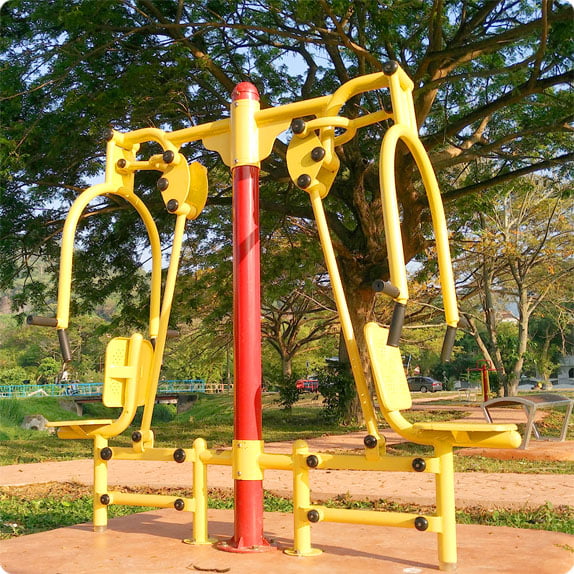
Outdoor gym equipment brings fitness into the school day, hard-wearing cross-trainers, cycles, multi-gyms and body-weight stations that build strength and stamina in the fresh air, all year round.
View outdoor gym equipment
A running track builds athletics and the daily mile into school life, straight sprint lanes for races and timing, or a marked circuit around the field or playground that a whole class can run every day.
View running tracks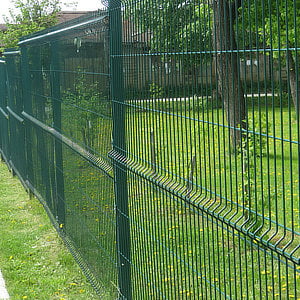
Rebound fencing keeps the game inside the court, sports-rated mesh or rebound-board fencing that stops balls escaping, keeps players safe and stands up to constant impact around MUGAs and pitches.
View muga fencingBook a free site visit and we'll measure up, recommend the right surface and send a clear, fixed quote.