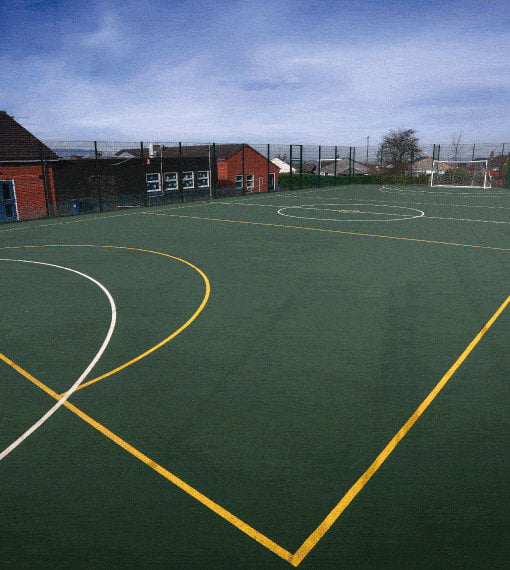
MUGA Pitches
A MUGA, Multi-Use Games Area, is a fenced, all-weather court line-marked for several sports at once, so one space hosts football, basketball, netball and tennis for PE, clubs and community hire.
View muga pitchesOutdoor gym equipment brings fitness into the school day, hard-wearing cross-trainers, cycles, multi-gyms and body-weight stations that build strength and stamina in the fresh air, all year round.
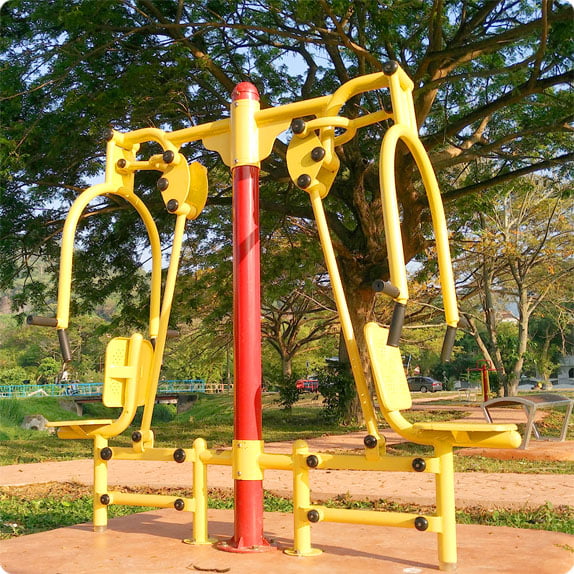
Outdoor gym equipment is a set of permanently installed, weatherproof fitness stations, governed by BS EN 16630, that brings cardio and strength training into the open air. We supply and install cross-trainers, exercise cycles, rowers, pull-up and push-up units and multi-gyms, built from hot-dip galvanised steel with HDPE panels and stainless-steel fixings.
Every station uses the user's own body weight for resistance, so there are no loose plates to load or lose. That makes the equipment safe for continuous class use and keeps servicing down to routine checks rather than part replacement, which is why an outdoor gym suits PE, fitness clubs and, on community builds, out-of-hours use.
Outdoor gym equipment works by using the user's own body weight as the resistance, so a pupil sets the effort by pace and position rather than by loading weights. Cardio stations such as cross-trainers, cycles and rowers raise the heart rate, while multi-gyms, pull-up bars and push-up units load the muscles, and sit-up and twist stations work the core.
We lay the stations out as a fitness circuit so a class or club moves station to station, working different muscle groups in turn. Each unit anchors into concrete footings for stability, and because there is nothing to add or lose the circuit stays safe for a full group cycling through it, one station after another.
Outdoor gym equipment is made from hot-dip galvanised steel, double powder-coated against corrosion, with HDPE seats and panels and stainless-steel fixings so it holds up to British weather with little upkeep. We install each station on cast in-situ concrete foundations, typically 300mm to 600mm deep, set to the manufacturer's footing detail for a stable anchor.
We can install on grass, wet-pour safety surfacing or a mix, matched to how the area will be used and to the freefall height of each station. Where a unit's fall height passes 0.6m we lay impact-absorbing surfacing beneath it, working to BS EN 1177 for that surface, and we can pair the gym with a trim trail or running track to extend the loop. See our trim trail and running track options.
Outdoor gym equipment is designed for KS2 pupils, secondary pupils and adults, with junior-scaled stations for children under 140cm in KS1 and KS2. We specify age-appropriate units and layouts, so a primary circuit uses lighter, lower stations while a secondary or community build carries full-size cross-trainers, cycles and multi-gyms.
The equipment supports the fitness strand of PE, gives a class a real training circuit, and on durable community-ready builds opens up out-of-hours use by families and local groups. We plan the mix and spacing of stations to your age groups and the space available, whether that is a compact early-years area or a full secondary fitness zone.
Individual outdoor gym stations cost around 800 to 2,500 pounds each supplied, and a school circuit of six to ten stations typically runs from about 8,000 to 25,000 pounds installed. These are indicative ranges to confirm at survey, not fixed prices: a single galvanised pull-up unit sits near the lower end at around 800 pounds, while a combined multi-gym or a full community-grade circuit reaches the upper figure.
Your final cost is driven by the number and type of stations, the concrete foundations, and whether the area needs safety surfacing beneath the equipment. Wet-pour surfacing under fall-height stations adds roughly 29 to 90 pounds per square metre, though units sat on grass or existing hardstanding avoid that. For a firm number, get an outdoor gym quote and we will price your exact site.
| Build | Stations | Indicative cost installed | Best for |
|---|---|---|---|
| Single station | 1 unit | £800 to £2,500 | Adding one piece to an existing area |
| Junior circuit (KS1 to KS2) | 4 to 6 units | £6,000 to £15,000 | Primary fitness, height under 140cm |
| School fitness circuit | 6 to 10 units | £8,000 to £25,000 | KS2 and secondary PE and clubs |
| Community-grade circuit | 8 to 14 units | £20,000 to £40,000+ | Out-of-hours and public use |
Indicative UK market ranges to confirm against your own pricing at survey. Foundations and any safety surfacing are priced on a site survey.
Outdoor gym equipment is governed by BS EN 16630:2015, the safety standard for permanently installed outdoor fitness equipment, which sets requirements for structural strength, ergonomics, accessibility, entrapment and the inspection regime. Where a station's freefall height passes 0.6m, the safety surfacing beneath it is also governed by BS EN 1177, the impact-attenuation standard.
Most gym stations sit at a low freefall height, often around 0.72m, so many fall just above the surfacing threshold and need impact protection to that height under and around them. We specify units and layouts to BS EN 16630, provide the required free space around each station, and can arrange independent RPII or RoSPA inspection where you want the installation signed off.
Outdoor gym equipment is made from hot-dip galvanised steel frames, powder-coated twice for colour and corrosion resistance, with HDPE (high-density polyethylene) seats and panels and stainless-steel or galvanised fixings. The galvanising protects the steel from rust, the double coating holds the colour through frost and sun, and the HDPE panels resist fading and impact.
This material set is what keeps upkeep to routine inspection rather than part replacement: there are no loose weights, cables or hydraulics to service on a body-weight station. We can match frame and panel colours to your school and, where a station carries moving parts, we specify sealed bearings so the mechanism runs with little more than an occasional check.
Outdoor gym equipment typically lasts 10 to 15 years or more with routine care, because the galvanised, double-coated steel resists corrosion and the body-weight design carries no plates, cables or hydraulics to wear out. HDPE panels hold up in the same band, resisting fading and weathering across British winters and summers.
We keep the equipment in that life through the inspection regime rather than heavy servicing: a daily or weekly visual check, a monthly operational check on stability and moving parts, and an annual RPII inspection. We also repair and refresh worn stations rather than rip and replace, extending the life of what you already have; see our sports facilities range for the wider fitness offer.
Outdoor gym equipment builds fitness into the school day, giving KS2 and secondary pupils a real training circuit of cardio and strength stations, tested to BS EN 16630 and usable all year round. Body-weight resistance means there is nothing to load or lose, so a full class or club can cycle through the stations safely at once.
The build does three more things well: galvanised, double-coated steel shrugs off the weather with only routine inspection, the circuit keeps a whole group active at the same time, and community-grade builds open up out-of-hours fitness for families and local groups. Stations sit on grass, wet-pour or a mix and pair with a trim trail for a longer fitness loop, so the equipment fits the space and the way it will be used.
Commercial Play designs, supplies and installs outdoor gym equipment in-house across England and Wales, so one team owns the job from survey to handover. We plan the station mix and spacing to your age groups and space, specify to BS EN 16630, and pour the concrete foundations and any BS EN 1177 surfacing to match.
We fit junior, secondary and community-grade stations, so our recommendation follows your site and users rather than one house package. We also lay outdoor gyms alongside trim trails and running tracks for a full fitness circuit, and repair worn stations instead of defaulting to replacement. Talk to us about your fitness area and we will tell you honestly what it needs.
Most outdoor gym stations are designed for KS2 pupils, secondary pupils and adults, with junior-scaled units for children under 140cm in KS1 and KS2. We specify age-appropriate stations and layouts, so a primary circuit uses lighter, lower units and a secondary or community build carries full-size cross-trainers, cycles and multi-gyms.
It uses the user's own body weight rather than loose weights or plates, so there is nothing to add or lose. That makes it safe for continuous class use, keeps a whole group active at once, and cuts maintenance to routine inspection rather than servicing loaded mechanisms.
Individual stations cost around 800 to 2,500 pounds each supplied, and a school circuit of six to ten stations typically runs from about 8,000 to 25,000 pounds installed. These are indicative ranges to confirm at survey, as the station count, foundations and any safety surfacing all move the figure.
Outdoor gym equipment is governed by BS EN 16630:2015, the safety standard for permanently installed outdoor fitness equipment, covering structural strength, ergonomics, accessibility and inspection. Where a station's freefall height passes 0.6m, the safety surfacing beneath it is also specified to BS EN 1177, the impact-attenuation standard.
Yes. Outdoor gym equipment can be installed on grass, wet-pour safety surfacing or a combination, each station anchored into concrete foundations. Where a unit's freefall height passes 0.6m we lay impact-absorbing surfacing beneath it to BS EN 1177, and units sat lower can go straight onto grass or hardstanding.
We recommend a daily or weekly routine visual check, a monthly operational check on stability and moving parts, and an annual inspection by an RPII-qualified inspector to BS EN 16630. Because the stations use body-weight resistance with no plates or hydraulics, this inspection regime is most of the upkeep.
Outdoor gym equipment typically lasts 10 to 15 years or more with routine care. The hot-dip galvanised, double powder-coated steel resists corrosion and the body-weight design has no plates, cables or hydraulics to wear out, while HDPE panels hold up in the same band across British winters and summers.
An outdoor gym is a set of fixed fitness stations for strength and cardio, while a trim trail is a route of physical challenges that combines fitness with balance and agility. Many schools install both for a fuller fitness offer, and we lay the two together as a longer loop.
It is made from hot-dip galvanised steel frames, powder-coated twice for colour and corrosion resistance, with HDPE seats and panels and stainless-steel or galvanised fixings. This material set is what keeps upkeep to routine inspection and lets us match frame and panel colours to your school.
Part of our full sports facilities range, explore the other surfaces below.
A MUGA, Multi-Use Games Area, is a fenced, all-weather court line-marked for several sports at once, so one space hosts football, basketball, netball and tennis for PE, clubs and community hire.
View muga pitches
Goal ends and sports walls turn any hard surface into a practice area, built-in goals, basketball hoops and rebound walls that let children shoot, pass and practise without full-court kit.
View goal ends & sports walls
A running track builds athletics and the daily mile into school life, straight sprint lanes for races and timing, or a marked circuit around the field or playground that a whole class can run every day.
View running tracks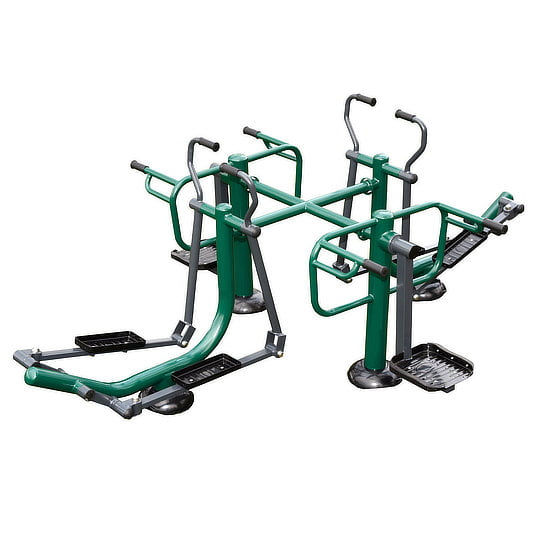
A trim trail is a route of physical challenges, balance beams, stepping logs, climbers and monkey bars, that builds fitness, balance and coordination while children think they are just playing.
View trim trails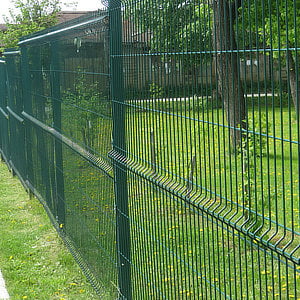
Rebound fencing keeps the game inside the court, sports-rated mesh or rebound-board fencing that stops balls escaping, keeps players safe and stands up to constant impact around MUGAs and pitches.
View muga fencingBook a free site visit and we'll measure up, recommend the right surface and send a clear, fixed quote.