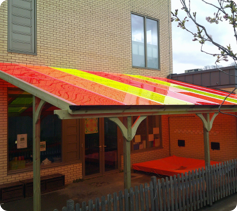
School Canopies
A school canopy is a roofed structure fixed to your building that turns the space by a door, dining hall or classroom into dry, shaded, all-weather space you can use every day of the year.
View school canopiesShade sails are tensioned fabric canopies that add colourful, cost-effective UV protection over sandpits, seating and early-years areas, the lightest, brightest way to get shade into a playground.
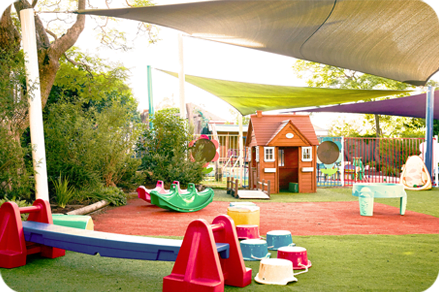
Playground shade sails are panels of tensioned, UV-stable HDPE fabric stretched between powder-coated steel posts to cast shade over the space below, blocking up to 95 to 97 percent of UV. We fit single sails or overlapping arrangements over sandpits, water play, early-years gardens and seating.
The fabric is a knitted high-density polyethylene mesh that shades the area while letting air move freely underneath, so heat is not trapped as it would be beneath a solid roof. Sails are the lightest-touch, lowest-cost way to add shade where sun and UV protection matter more than full weatherproof cover.
Playground shade sails are made from UV-stabilised HDPE monofilament knitted in a raschel lock-stitch, typically around 320gsm commercial-grade fabric, edged with a reinforced webbing and stainless steel fittings. We set powder-coated or galvanised steel posts into concrete foundations, then tension each sail lightly across those fixing points.
The posts are engineered to wind and snow loading, and the sail is tensioned only enough to take the sag out of the fabric, since over-tensioning strains the posts and fixings. Where a sail spans a route or a wider area we fix to the building at one edge, so a made-to-measure sail can follow the exact shape of the space rather than a stock rectangle.
Playground shade sails work best over sandpits, water play, early-years gardens, seating and dining spots, and any sunny corner where cooling shade and UV protection are the priority for children under 11. They suit EYFS and primary settings where summer sun exposure over open play is the concern.
Many schools use sails and a solid canopy together: bright sails for summer shade over play, and a polycarbonate-roofed school canopy for the doors and dining areas that need year-round dry cover. Where the priority is all-weather teaching space, an outdoor classroom is the better fit.
Playground shade sails start at around 3,800 pounds installed for a single 3m x 3m sail with steel posts and concrete foundations, and larger or overlapping arrangements run higher. This is an indicative figure to confirm at survey, not a fixed price: the sail size, the number of posts, the fabric grade and the ground conditions all move it.
A shade sail is a lower-cost way to shade a large area than a fully roofed canopy, which is why it suits early-years and play areas on a lighter budget. The main cost drivers are the sail area (sizes run up to about 7.0m x 7.0m), how many steel posts and foundations are needed, and site access for the groundworks. For a firm number, get a shade sail quote and we will price your exact site.
| Feature | Shade sail | Solid-roof canopy |
|---|---|---|
| Primary purpose | Sun and UV shade | Year-round dry cover |
| Roof material | HDPE fabric (around 320gsm) | Polycarbonate on steel |
| UV block | Up to 95 to 97 percent | Full cover plus UV block |
| Rainproof | Sheds light showers only | Fully weatherproof |
| Indicative cost | From about 3,800 pounds (3m x 3m) | Higher per square metre |
| Lifespan | 10 to 15 years | Decades |
Indicative UK market comparison to confirm against your own pricing at survey. Fabric and canopy costs vary with size, span and site conditions.
Playground shade sails are engineered to wind and snow loading, with steel posts sized and foundations designed by structural calculation so the structure stays safe in a UK winter. Unlike impact-absorbing surfacing, a shade sail is not fall-height equipment, so BS EN 1177 does not apply to the sail itself.
Where a sail sits over or beside play equipment, that equipment is governed by BS EN 1176 and its safety zones must stay clear of the posts. We position posts outside the fall zone, use stainless steel fixings for corrosion resistance, and can arrange independent RPII inspection of the wider play area where you want it signed off.
Playground shade sails use UV-stabilised HDPE knitted fabric, typically around 320gsm commercial grade, that blocks up to 95 to 97 percent of UV while staying breathable so heat passes through rather than building up underneath. Sails come in bright colours, single or overlapping, in squares, rectangles and triangles.
Individual sails run up to about 7.0m x 7.0m, and we combine several where one span will not cover the area, with shared posts acting as fixing points for more than one sail. The HDPE mesh lets rain and wind pass through, which reduces wind lift and stops water pooling on the fabric.
Playground shade sails last 10 to 15 years with routine care, and the fabric usually carries a UV-degradation warranty of up to 10 years against fading and breakdown. The steel posts and concrete foundations last far longer, so a re-tension or a fabric replacement extends the installation rather than a full rebuild.
Fabric can stretch, sag or fade over a decade of sun, so many schools take sails down over winter to shed wind and snow loading and add years to their life, then re-fit them for the summer term. We can re-tension a sagging sail or supply a replacement panel to the same fixing points.
Playground shade sails protect children by blocking up to 95 to 97 percent of UV over sandpits, seating and play areas, keeping those spaces cooler and safer through summer. The breathable HDPE fabric adds three more things: it lets hot air escape, it lets light rain and wind pass through to cut lift, and it adds bright colour without a heavy structure.
Sails cost less than a fully roofed canopy to shade the same area, which stretches an early-years budget further. They can be taken down for winter to extend their life, and a made-to-measure sail follows the exact shape of a sandpit, garden or seating area rather than forcing a stock square. Pair them with school canopies for the areas that need year-round dry cover.
Commercial Play designs, supplies and installs playground shade sails in-house across England and Wales, so one team owns the job from survey to handover. We measure the area, size the sails and steel posts to your space, and set the foundations clear of any BS EN 1176 safety zones around nearby equipment.
We fit the full canopy range as well as sails, so our recommendation follows your site rather than the one product we sell: a light, colourful sail where summer shade is the priority, or a solid canopy or shelter where you need year-round dry cover. Talk to us about your play area and we will tell you honestly what it needs.
Indicatively, a single 3m x 3m shade sail with steel posts and concrete foundations starts at around 3,800 pounds installed, with larger or overlapping arrangements costing more. This is a market range to confirm on a site survey, as the sail size, the number of posts and the ground conditions all move the figure.
Shade sails are designed for sun and UV protection rather than rain. The breathable HDPE fabric sheds light showers and lets water pass through to stop pooling, but it is not a fully weatherproof roof. For all-weather dry cover, choose a solid-roof canopy or shelter.
Quality HDPE shade-sail fabric blocks up to 95 to 97 percent of UV radiation, which is why sails are popular over sandpits and early-years areas where sun protection matters most. The knitted mesh gives that protection while staying breathable, so heat is not trapped underneath.
Shade sails last 10 to 15 years with routine care, and the fabric typically carries a UV-degradation warranty of up to 10 years. The steel posts and foundations last far longer, so a fabric replacement or re-tension extends the installation rather than a full rebuild.
Often, yes. Many schools remove sails over winter to protect them from wind and snow loading and to extend their lifespan, then re-fit them for the summer term. The steel posts stay in place, so re-fitting is quick.
Individual sails run up to about 7.0m x 7.0m in squares, rectangles and triangles, and we combine several where one span will not cover the area. Shared posts act as fixing points for more than one sail, so overlapping arrangements can shade a wider space.
Shade sails are made from UV-stabilised HDPE monofilament knitted in a raschel lock-stitch, typically around 320gsm commercial-grade fabric, with reinforced edging and stainless steel fittings. They mount on powder-coated or galvanised steel posts set into concrete foundations.
Over sandpits, water play, early-years gardens, seating and dining spots, and any sunny corner of the playground where cooling shade and UV protection are the priority. Many schools pair sails with a solid canopy for the doors and dining areas that need year-round cover.
The posts and foundations are engineered to wind and snow loading by structural calculation. A shade sail is not fall-height surfacing, so BS EN 1177 does not apply to it, but where a sail sits near play equipment we keep posts clear of the BS EN 1176 safety zones.
Part of our full canopies & shelters range, explore the other surfaces below.
A school canopy is a roofed structure fixed to your building that turns the space by a door, dining hall or classroom into dry, shaded, all-weather space you can use every day of the year.
View school canopies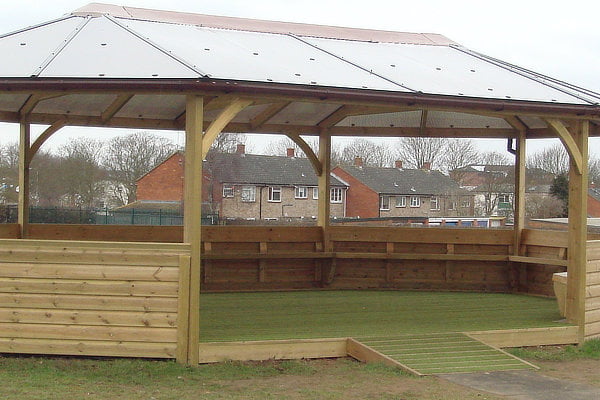
An outdoor classroom is a free-standing covered structure that gives you a permanent, all-weather space for forest-school lessons, group work and assemblies out in the grounds, away from the main building.
View outdoor classrooms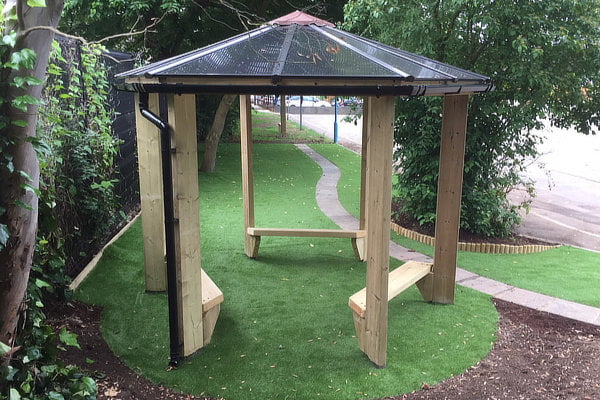
A covered walkway is a roofed link between two points on a school site, building to building, gate to entrance, or classroom to dining hall, so pupils and staff stay dry on the routes they use most.
View covered walkways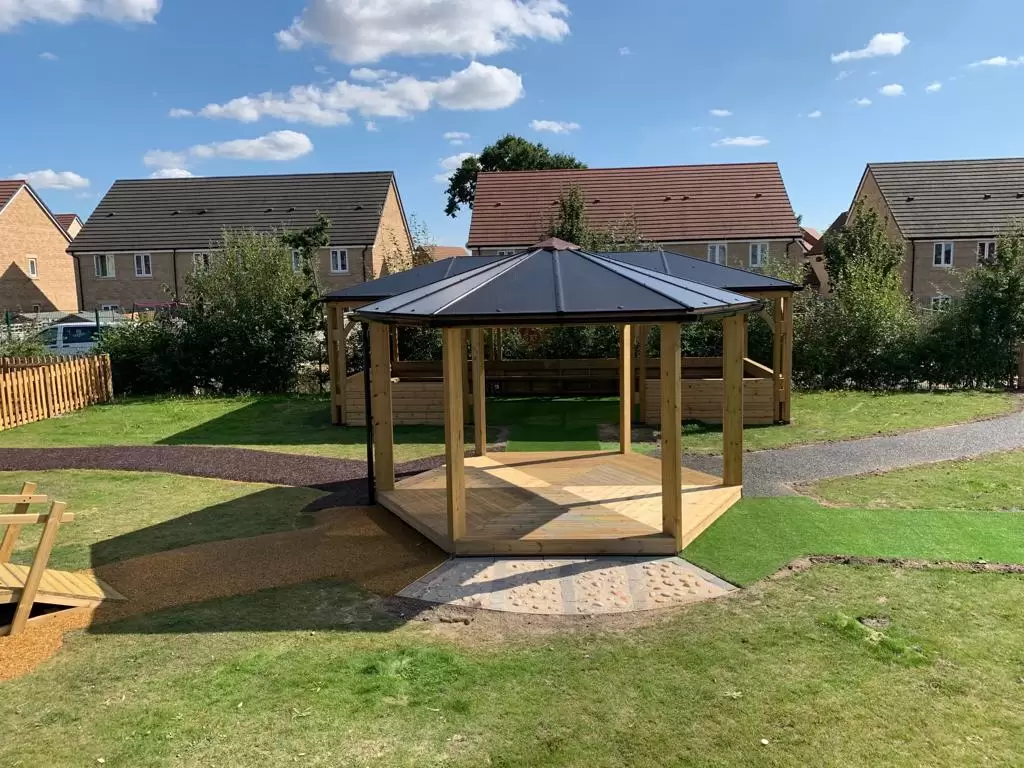
Outdoor seating and picnic benches give children somewhere to eat, talk and rest, from hard-wearing picnic tables and buddy benches to shaded seating built into a canopy or gazebo.
View seating & picnic benches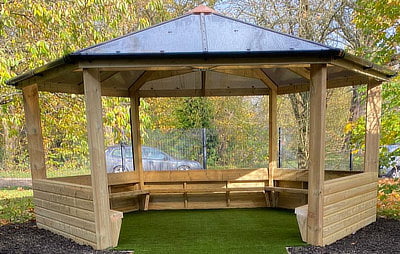
An outdoor stage or storytelling area gives children a place to perform, present and gather, a raised deck for performances or a circle of seating around a focal point for stories, assemblies and group talk.
View stages & storytellingBook a free site visit and we'll measure up, recommend the right surface and send a clear, fixed quote.