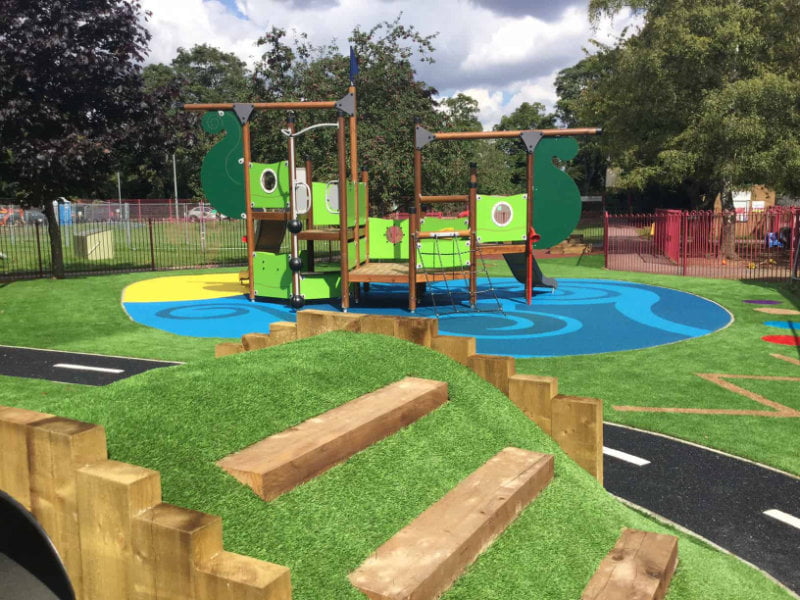
Role Play Units
Themed timber units shaped like boats, cars, buses, trains, shops and stages become whatever children imagine, turning a corner of the playground into the setting for endless stories.
View role play unitsTimber playhouses, dens and loose-parts den-building kits give children a small world of their own to build, share and reinvent through open-ended imaginative play.
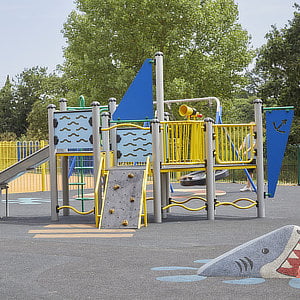
Play houses and den making areas are child-sized timber buildings and loose-parts kits (posts, panels, fabric and A-frames) that children assemble into their own shelters for open-ended imaginative play. A fixed play house is a weatherproof focal point ready for home-corner and shopkeeper play the moment children arrive; a den making area is the space and the loose parts they build and rebuild each session.
This kind of play matters because it is open-ended. With no fixed rules, children invent the story themselves, which builds language, negotiation and cooperation as they decide together who lives here and what happens next. It sits at the heart of forest school and early-years talk, so we often pair it with a nearby mud kitchen.
We build play houses and den making areas from pressure-treated softwood (redwood pine), planed smooth and pencil-rounded so there are no splinters or sharp edges, and we install both to BS EN 1176, the standard for outdoor play equipment. Fixed play houses are craned or hand-built on prepared ground; den kits arrive as manageable posts, panels and connectors that children lift and slot together themselves.
A fixed play house needs almost no setting up and copes with heavy daily use, sitting on grass, an existing hard surface or a raised timber deck. Where a den area or play house has a raised platform or step, we set the posts on galvanised steel feet or in-ground and match the surfacing to the fall height. Rounded connectors and age-sized parts on the den kit keep adult-supported building safe for the group using it.
Play houses and den making areas work well from early years through to lower juniors, so nurseries, primary schools and forest school settings across England and Wales are the typical buyers. Fixed play houses suit nursery and reception home-corner play, while loose-parts den building tends to engage children aged around 5 to 11 who enjoy planning and problem-solving.
Many settings choose both, so there is somewhere ready to play and somewhere to build. A play house anchors early-years talk and personal, social and emotional development, and a den kit fits forest school, risk assessment and outdoor learning. Both pair naturally with boats and role play units to widen the small-world scene.
A fixed timber play house costs around 1,500 to 8,000 pounds installed, and a purpose-made den building kit starts from a few hundred pounds for a loose-parts set up to around 3,000 pounds for a larger fixed den frame. These are indicative UK ranges to confirm at survey, not fixed prices: a simple home-corner play house sits at the lower end, while a raised, decked or multi-room design reaches the top of the band.
Your final cost is driven by the size and design of the play house, whether there is a raised platform, the number and type of loose parts in the den kit, the groundworks and site access. Safety surfacing to a raised deck adds separately where the fall height calls for it. For a firm number, get a play houses and dens quote and we will price your exact site.
| Option | Typical footprint | Age range | Indicative cost installed | Best for |
|---|---|---|---|---|
| Fixed timber play house | 2m x 2m to 3m x 3m | 2 to 7 (EYFS to KS1) | £1,500 to £8,000 | Home-corner and shopkeeper play, daily use |
| Raised play house with deck | 2m x 2m plus platform | 3 to 7 | £4,000 to £8,000+ | Added level, slide or shop counter |
| Loose-parts den kit | Stored, set out per session | 5 to 11 (KS2, forest school) | From a few hundred pounds | Building, problem-solving, forest school |
| Fixed den frame / A-frames | 2m x 2m to 3m x 3m | 4 to 11 | Around £1,000 to £3,000 | A permanent den structure children dress and rebuild |
Indicative UK market ranges to confirm against your own pricing at a site survey. Surfacing to any raised deck is priced separately by fall height.
Play houses and den making areas are governed by BS EN 1176, the standard for permanently installed outdoor play equipment, which sets entrapment, edge and structural rules and calls for inspection through the equipment's life. Where a play house or den has a raised platform or step, the free height of fall is covered by BS EN 1177, the impact-attenuation standard for the surface beneath it.
BS EN 1176 requires no head or finger entrapment gaps, rounded edges and sound structure, and safety surfacing is required wherever the free fall exceeds 0.6m. On a ground-level home-corner play house with no raised deck, grass or an existing hard surface is usually enough; on a raised deck we lay and test surfacing to BS EN 1177 so any tumble is cushioned. We can also arrange independent RPII or RoSPA inspection where you want the installation signed off.
Play houses and den making areas are built from pressure-treated softwood posts and panels, typically 90mm to 100mm square posts and 20mm to 45mm boards, with a footprint of around 2m x 2m up to 3m x 3m for a fixed play house. The timber is planed smooth and pencil-rounded, and the treatment is pressure-forced into the wood so it needs no annual re-coating.
Den kit parts are sized for the age group, with manageable posts, rounded connectors and A-frames a child can lift and carry safely. Roofs are usually shingle, felt or timber, and a raised model adds a platform, steps and a rail set to BS EN 1176 heights. We set posts either in-ground or on galvanised steel feet, which lift the timber clear of the ground and extend its life at the base. Not sure what suits your space? Book a free site survey and we will work it out.
A pressure-treated timber play house typically lasts 15 years or more, with treatment warranties of 15 to 20 years common for school and park timber when posts are set on steel feet rather than straight into the ground. We present 15 years and up as a fair indicative life to stand behind, given the damp UK climate that shortens the life of any untreated softwood.
Loose-parts den kits last a similar span because the parts are the same treated timber, and being lifted in and out of store keeps them off wet ground between sessions. We also repair and refresh worn boards, rails and roofs rather than rip and replace, so a play house you already have can be brought back into daily use. Pair a long-lived den area with all our themed play range for a joined-up scene.
Play houses and den making areas give children open-ended play with no fixed rules, so they invent the story and lead it themselves, which grows language, storytelling and the confidence to speak up. A good set-up does three more things well: it builds cooperation as children take turns and negotiate, it anchors forest school and early-years learning, and it stands up to years of daily outdoor use.
Small-world talk around a play house feeds vocabulary and early maths as a shop counter becomes a class till. A den kit adds planning, lifting and problem-solving that suits older groups, teaching risk assessment and teamwork. And because the timber is pressure-treated and pencil-rounded to BS EN 1176, the equipment carries this daily use through the seasons with routine care, not constant repair.
Commercial Play designs, supplies and installs play houses and den making areas in-house across England and Wales, so one team owns the job from survey to handover and works everything to BS EN 1176 and, where there is a raised deck, BS EN 1177. We survey each site, match the play house or den kit to your age groups and space, and specify the timber, footprint and any surfacing rather than a house default.
We fit both fixed play houses and loose-parts den kits, so our recommendation follows how your children play rather than the one product we happen to stock, and many settings take both. We also repair and refresh worn timber instead of defaulting to full replacement. Talk to us about your play area and we will tell you honestly what it needs, and how it pairs with boats and role play units.
Both work well from early years through to lower juniors. Fixed play houses suit nursery and reception home-corner play from around age 2 to 7, while loose-parts den building engages children aged roughly 5 to 11 who enjoy planning and problem-solving in forest school and outdoor learning.
Indicatively, a fixed timber play house is around 1,500 to 8,000 pounds installed, and a purpose-made den kit starts from a few hundred pounds up to around 3,000 pounds for a fixed den frame. These are UK market ranges to confirm on a site survey, as size, a raised deck, groundworks and access all move the figure.
Yes, when they use purpose-made kits with rounded connectors and manageable parts sized for the age group. Equipment is designed and installed to BS EN 1176, the standard for outdoor play equipment, and adult-supported building teaches children to handle materials sensibly.
A fixed play house with no raised platform usually sits on grass or an existing hard surface. Where there is a step or a raised deck and the free fall exceeds 0.6m, we match the surfacing to the fall height and test it to BS EN 1177 so any tumble is cushioned.
We build both from pressure-treated softwood, typically redwood pine, planed smooth and pencil-rounded so there are no splinters or sharp edges. Posts are around 90mm to 100mm square, and we set them in-ground or on galvanised steel feet that lift the timber clear of wet ground and extend its life.
A pressure-treated timber play house typically lasts 15 years or more, with 15 to 20 year timber treatment warranties common for schools when posts sit on steel feet. Loose-parts den kits last a similar span because being stored between sessions keeps them off wet ground.
Den making is a natural fit for forest school, encouraging risk assessment, teamwork and outdoor learning. Home-corner play houses link to early-years talk and personal, social and emotional development, so both earn their place in the daily routine and pair well with a nearby mud kitchen.
A fixed play house gives an instant, weatherproof focal point ready for daily home-corner play with almost no setting up. A den kit is more flexible and more challenging, as children plan, lift and problem-solve to make something new each session. Many settings choose both, so there is somewhere ready to play and somewhere to build.
Yes. We design them alongside boats and role play units and the full themed play range, placing each piece so it draws children in without blocking the flow of the wider playground. One team surveys, specifies and installs the whole scene to BS EN 1176 across England and Wales.
Part of our full themed play range, explore the other surfaces below.
Book a free site visit and we'll measure up, recommend the right surface and send a clear, fixed quote.